

Beyond the code: How ICD-O classification changes are redefining cancer in insurance
Article information and share options
This article was written
By
Executive Summary
The International Classification of Diseases for Oncology (ICD-O) is the globally recognised standard for classifying and coding tumours according to their anatomical site (topography), histological characteristics (morphology) and presumed tumour biology (behaviour), based primarily on pathology and tissue examination findings. Since its introduction by the World Health Organization (WHO), the ICD-O has undergone several revisions to reflect advances in cancer research, diagnostics and tumour classification. The most recent update, ICD-O-4, has been released in July 2026 and thus represents the latest evolution of the system, with respective changes potentially relevant to the insurance industry.
Evolution of ICD-O classification (1976-2026)
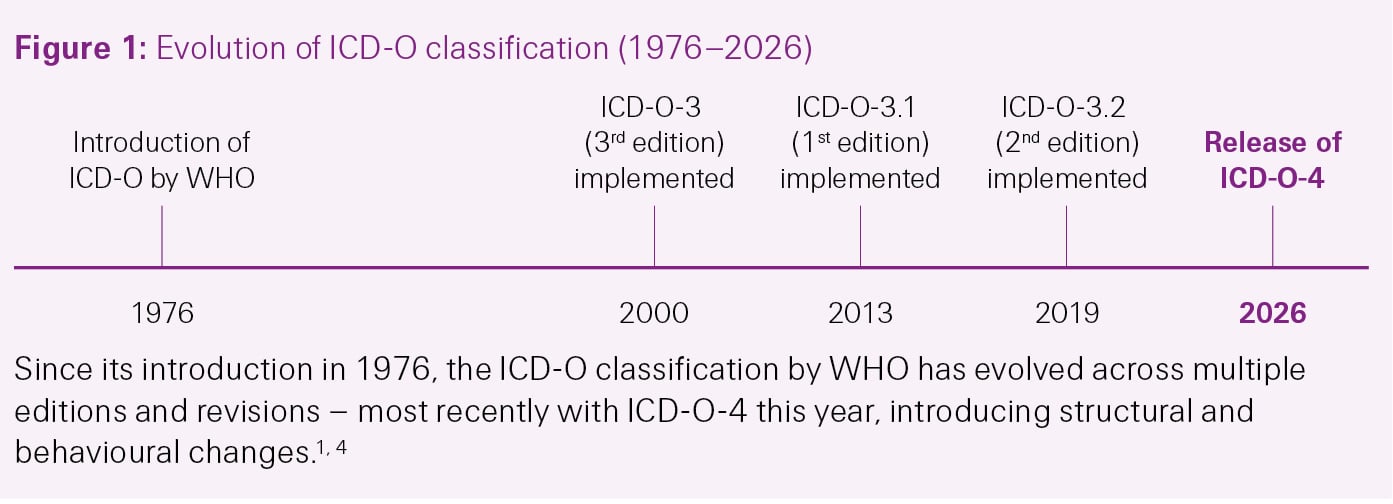
As our understanding of cancer continues to develop, tumour classifications are becoming increasingly refined and precise. For insurers, staying informed about these changes is essential to support consistent underwriting and claims assessments, promote fairness for policyholders, and maintain the long-term sustainability of insurance portfolios in an evolving healthcare landscape.
These approaches have improved outcomes for selected cancers, although benefits remain highly dependent on cancer type, stage, tumour biology and treatment access. Overcoming treatment resistance, managing side effects and expanding access remain important challenges.
Key findings
- ICD-O behaviour code changes may alter whether a tumour is formally classified as malignant, potentially affecting claims interpretation and portfolio risk and pricing assumptions where insurance terms rely on that classification.
- Formal malignancy classification may not always reflect clinical behaviour, prognosis or disease impact. It should therefore be interpreted alongside the underlying pathology, clinical evidence and applicable policy terms.
- As classifications evolve, monitoring exposure within existing portfolios and considering prognosis and material disease impact, rather than diagnosis alone, in future product design may help preserve product intent and build resilience to future classification changes.
Tags
Authors

Tobias Schiergens

Kent Chong
