


Catalysing sovereign resilience with Insurance Linked Loans
This article was written by Gerry Lemcke
Listen to this article
When disaster strikes, the immediate images are jarring: submerged homes, damaged buildings, failed crops. In emerging economies, these stark first images often overshadow a slower-burning financial crisis: enormous bills for emergency relief and reconstruction, accompanied by collapsing revenues.
For nations that rely on loans from multilateral institutions and donors to fund infrastructure and economic growth, debt repayment obligations that continue after a disaster can also sap precious financial resources. A paradox emerges, as the very loans that enable development become an obstacle to recovery.
Recently, the ability to defer loan repayments has offered select countries a lifeline. Climate-resilient debt clauses (CRDCs) let them temporarily redirect interest and principal payments to catastrophe recovery. Ultimately, however, the payments are only postponed. This is why it's worth examining further options to address post-disaster sovereign debt stress, especially when finances are tight, donors want to magnify their impact yet manage their risks, and as natural catastrophes grow more frequent and intense.
At Swiss Re Public Sector Solutions, we believe the timing is right to invest more boldly in the concept of Insurance Linked Loans (ILL), a risk-transfer innovation that can benefit all parties aiming to strengthen sovereign disaster resilience. These financing instruments include protection to cover debt repayments in the event of a triggering catastrophe, a powerful way to achieve catalytic outcomes where every dollar of donor funding can drive more than a dollar's worth of long-term impact.
In our new paper Insurance Linked Loans: Advancing Sovereign Disaster Risk Financing Beyond Climate Resilient Debt Clauses, we demonstrate the competitiveness of ILLs through a series of simulations. The paper also addresses key challenges such as definitions of insurable events and duration mismatch, while offering solutions to overcome these hurdles.
ILLs have great potential as part of a broad risk-reduction portfolio that already includes parametric insurance, catastrophe bonds, and contingent lines of credit, by helping countries not merely to buy time but truly transfer their risks.
A tale of two disasters
The experience of the last two decades highlights why having a range of risk-management alternatives is critical. For instance, when Hurricane Ivan hit Grenada in the Caribbean in 2004, the storm destroyed nearly all of the island's housing, precipitating a humanitarian emergency that led to a sovereign debt default.
Fast forward 20 years: when Hurricane Beryl struck in 2024, the country made history as the first to leverage a deferral to postpone debt repayments. Absent debt deferral, still-fragile Grenada would have faced millions in payments during coming months; with it, the island won much-needed financial breathing room to meet residents' pressing post-disaster needs.
The rub, of course, is that deferrals are only that – a postponement. The overall debt obligations remain unchanged, while recovery efforts will go much beyond a short payment holiday; when they resume, they will come on top of an economy still facing distress from the storm.
Such deferrals can be an integral part of the disaster-resilience solution, but they shouldn't be the end of the discussion. To this end, insurance designed to cover loan repayments following a catastrophic event offers significant advantages.
With Insurance Linked Loans, borrowers can get swift, permanent debt relief. Moreover, all parties to sovereign debt transactions benefit from more stable payment schedules and predictable risk management offered when loans and insurance covers can be arranged simultaneously in a convenient process.
Such certainty can create a virtuous cycle, as well: safer credit attracts more investors to sovereign lending, while more investors can help improve interest rates and loan terms. Collaboration between governments, development banks, and private investors can facilitate greater lending capacity for countries that struggle to access global finance.
The challenges can be overcome
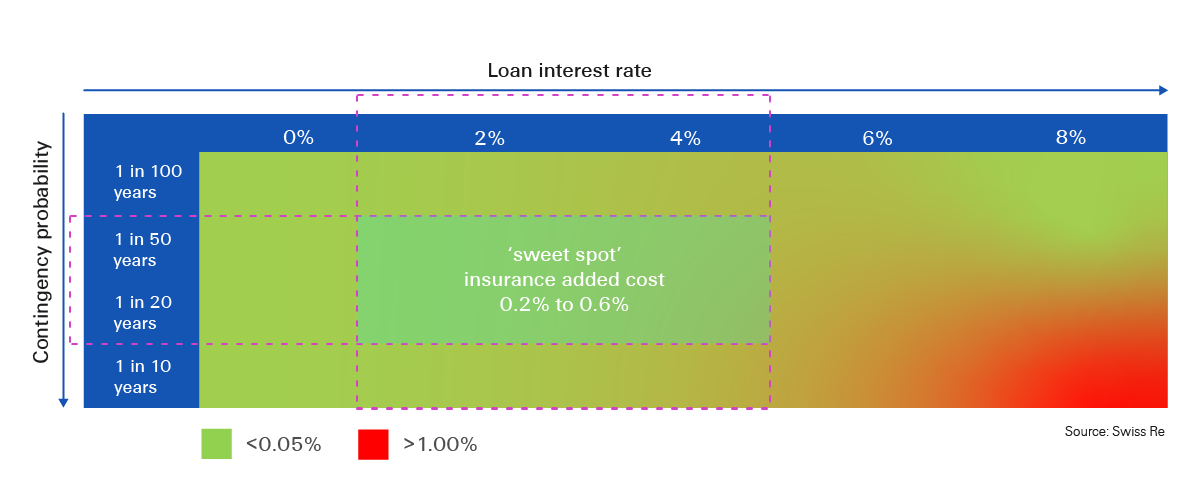
Catastrophe insurance for sovereign debt does come with a premium. However, Swiss Re has explored plausible scenarios that identify an attractive "sweet spot" where insurance can help meet immediate post-disaster relief needs, save countries millions of dollars after a catastrophe, and bolster creditor confidence.
An added cost of between 20 to 60 basis points may appear expensive in relative terms, if compared to conditions particularly of concessional loans. In absolute terms, however, the costs are fully comparable with commitment or standby fees of many contingent loan instruments with an active deferral estimated to cost upwards of 25 basis points; hence, premium cost of an insurance-linked loan with permanent debt relief should not be seen as prohibitive.
Loan interest rate
We also examined counterarguments that loan insurance might not provide sufficient recovery relief, especially considering the often-enormous financial burden that materialises following disasters like hurricanes or earthquakes. But when you do the simulations, the unencumbered liquidity that insurance can unlock is much more powerful than you'd first expect.
Take Grenada: an Insurance Linked Loan, had it been in place when Hurricane Beryl made landfall in 2024, could have freed up money sufficient to cover a significant part of the country's immediate emergency liquidity needs, based on benchmarks factoring in total recovery costs and GDP.
Unlike a deferral, there would be genuine risk transfer with permanent debt relief, with no need to modify repayment schedules or increase future installments. Insurance Linked Loans are not designed to replace risk transfer instruments of larger capacity such as traditional dedicated insurance solutions like insurance-linked securities including catastrophe bonds, but they do offer a powerful complement within a strong disaster resilience strategy.
Adding to our resilience-building toolbox
Swiss Re has delivered public sector risk-transfer solutions since 2011 and we've written recently how we aim to deepen our engagement with governments, industry and multilateral partners to provide more effective, sustainable protection against earthquakes, windstorms, droughts, floods, and extreme heat. Insurance Linked Loans, as another tool in our resilience-building toolbox, are an ideal fit in this effort.
The concepts behind them are actually not new. Particularly in agriculture, multiperil insurance is often directly bundled with loans necessary to offer the farmers both access to funding and crop protection.
Still, insurance can play an even larger role in sovereign lending as part of a multi-layered resilience strategy that is scalable and replicable. After all, private-sector infrastructure projects would be unthinkable without covers to protect stakeholders from the worst. Risk transfer scaled for sovereign loan programmes offers similar benefits: swift financial support, lower long-term costs, more stable credit relationships, and greater investor confidence.
By going beyond debt deferrals, Insurance Linked Loans can create lasting stability, enabling borrowers and creditors to manage growing disaster risks while concurrently building a sturdier, more inclusive global financial system.
Disclaimer
Disclaimer
Audio narration of this text is AI generated.
Tags
authors Connect with us
