


Risk Management
Sound risk management is key to Swiss Re's financial strength
Effective risk management is an integral part of Swiss Re's business model and key to the controlled risk-taking that underpins our financial strength. The practice is embedded throughout our business - structurally and methodically - to ensure good risk taking.
Sound risk management is essential for a re/insurer. Tight control of our exposures guarantees that we can fulfil our role in society as ultimate risk-taker and be a reliable partner to our clients when they need us. The core categories of our risk landscape comprise
- Insurance risk - property and casualty, life and health,
- Financial market and credit risk
In addition, we pay close attention to further significant risks we may be exposed to, especially in the longer term. Sustainability, political, regulatory and emerging risks are particularly relevant in this respect. We have developed instruments and know-how that help us identify and assess all of them because of their potential to increase losses, for ethical reasons, or both.
Group Risk Management function is key to enabling sound risk taking across Swiss Re
Group Risk Management is a global function mandated to ensure that Swiss Re Group and legal entities have the necessary expertise, frameworks and infrastructure to support sound risk-taking. In addition, it monitors and ensures adherence to applicable frameworks and also performs reserving and reporting activities. Embedded throughout our business, we have Chief Risk Officers (CROs) and risk teams for all major legal entities and regions. There are closely aligned to Swiss Re's business structure in order to ensure effective risk oversight but remain part of our Group Risk Management function under the Group CRO. They are supported in this by central risk teams that provide specialised risk expertise and oversight.
Swiss Re's risk management is based on four fundamental principles
We apply these principles consistently across all risk categories at Group and legal entity level.
- Controlled risk-taking - Financial strength and sustainable value creation are central to Swiss Re's value proposition. The Group thus operates with a clearly defined risk policy and risk control framework.
- Clear accountability - Swiss Re's operations are based on the principle of delegated and clearly defined authority. Individuals are accountable for the risk they take on, and their incentives are aligned with Swiss Re's overall business objectives
- Independent risk controlling - Dedicated units within Risk Management control all risk-taking activities. These are supported by Compliance and Group Internal Audit functions
- Open risk culture – Risk transparency, knowledge sharing and responsiveness to change are integral to the risk control process. The central goal of risk transparency is to create a culture of mutual trust, and reduce the likelihood of surprises in the source and potential magnitude of losses
Swiss Re operates within a clearly defined Risk Control Framework
This is set out in the Group Risk Management Standards and comprises a body of standards that establish an internal control system for taking and managing risk. These standards set responsibilities for risk takers and risk controllers. The risk control framework defines key tasks, which are the core components of Swiss Re’s risk management cycle:
- Limit setting and monitoring – allows Swiss Re to control its risk-taking decisions and total risk accumulations, including the passive risk the company is exposed to through its operations.
- Risk oversight of plan – ensures that the risk implications of plans are understood, and determines whether business and investment plans adhere to the internal risk appetite framework, including risk appetite and tolerance.
- Risk identification and exposure quantification – ensures that all risks to which Swiss Re is exposed are transparent in order to make them controllable and manageable.
- Risk assessment – enables Swiss Re to understand the magnitude and nature of its risks through quantitative and qualitative analysis, ensuring that the company operates within its risk appetite.
- Risk reporting – creates internal risk transparency and enables Swiss Re to meet external disclosure requirements.
Swiss Re's risk-taking is steered by its Risk Appetite Framework
Our Risk Appetite Framework consists of two interlinked components: risk appetite and risk tolerance. The risk appetite statement facilitates discussions about where and how Swiss Re should deploy its capital, liquidity and other resources under a risk-return view, while the risk tolerance sets clear boundaries to risk-taking.
Our proprietary integrated risk model provides a meaningful assessment of the risks to which Swiss Re is exposed to and represents an important tool for managing our business. It determines the capital requirements for internal purposes and forms the basis for regulatory reporting under the Swiss Solvency Test (SST) and under Solvency II for our legal entities in continental Europe. With the approval of our internal model under FINMA's, the Swiss Financial Market Supervisory Authority, revised process, we achieved a key milestone in 2017.
We continuously review and update our internal model and it's parameters to reflect our experiences and changes in the risk environment and current best practice.
Swiss Re uses a full internal risk model
The internal risk model provides a meaningful assessment of the risks to which the company is exposed and is an important tool for managing the business. Swiss Re’s model has a history of more than 20 years of development and continuous improvement driven both by the company’s specific risk profile and by changing requirements as a globally operating reinsurer.
While economic solvency regimes such as SST and Solvency II offer standard models for calculating regulatory requirements, such models are generally geared towards regulating the local or regional insurance market and thus do not take sufficient account of Swiss Re’s broad geographic and diversified portfolio structure. Swiss Re’s model uses the Monte Carlo simulation method to estimate a joint multivariate distribution of all relevant risk factors, rather than a limited set of deterministic scenarios and factors. It therefore provides more detailed results than standard formulas, which are often based on simplified industry-wide common denominators.
Swiss Re’s internal model is based on two important principles. First, it applies an asset-liability management approach, which measures the net impact of risk on the economic value of both assets and liabilities. Second, it adopts an integrated perspective, recognising that a single risk factor can affect different sub-portfolios and that different risk factors can have mutual dependencies. Swiss Re’s internal model is fully stochastic and is based on a separation of risk factors and exposure functions.
The model generates a probability distribution for economic profit and loss, specifying the likelihood that the outcome will fall within a given range.
Internal risk model
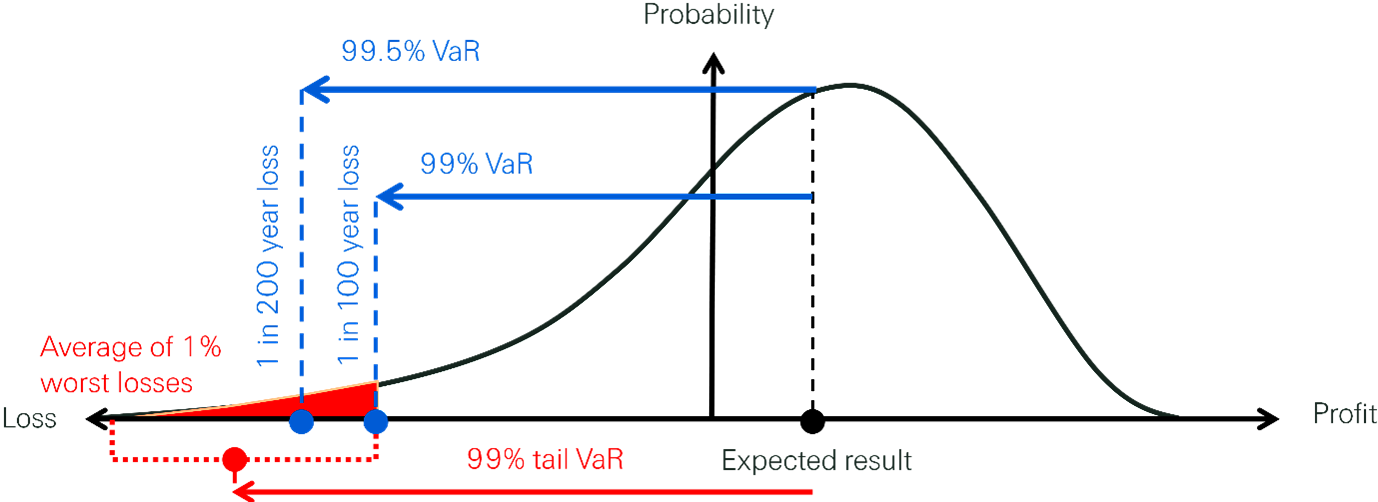
In line with the SST, the Group measures its economic risk capital requirement as the 99% expected shortfall (or tail value at risk) level. This represents an estimate of the expected value of annual losses likely to occur with a frequency of less than once in one hundred years, thus capturing the potential for severe, but rare, aggregate losses.
In addition, the model is used to calculate value at risk (VaR) measures, including 99.5% VaR which is used in other regulatory regimes such as Solvency II. 99.5% VaR represents the loss likely to be exceeded in only one year out of two hundred and is thus more severe than the 99% VaR measure, which estimates the loss likely to be exceeded in one year out of one hundred. For Swiss Re’s loss distribution, the 99% expected shortfall (tail VaR) measure is generally larger than the 99.5% VaR measure.
Separate risk modules are used to model the individual risk factors of Swiss Re’s core risks. Depending on the underlying risk and available historic experience, Swiss Re applies different modelling approaches:
- Non-life insurance risk – Swiss Re’s model comprises several components for non-life risks: One main contributor is costing and reserving risk; this is modelled based on a statistical model approach which derives its assessment of future uncertainty from the observation of past volatility. Another key component of non-life insurance risk are natural catastrophes: Swiss Re has developed its own proprietary natural catastrophe models, which are used for costing as well as risk assessment. In addition, Swiss Re uses a number of so-called threat scenario models, which are used to describe large but rare events (ie events that are not well represented in historical observations). Events involve the accumulation of simultaneous losses from different parts of the portfolio at the same time. Swiss Re also models claims inflation risk evolving from the Group’s property and casualty business. Since economic inflation changes the value of a liability or an asset, it generally induces changes in claims payment. Inflation risk is modelled by applying a probabilistic set of future inflation scenarios based on expert judgement about future inflation.
- Life insurance risk – Swiss Re’s model quantifies potential economic losses from L&H business generated by non-financial risks. The model comprises separate sub-models based on the nature of Swiss Re’s product offerings: mortality, longevity, critical illness, hospital cash and income protection. Each sub-model is a cashflow model based on actuarial valuation models with a consistent structure, identifying the underlying risk factors. Some risk factors, such as the prevalence of certain diseases, can influence mortality as well as critical illness products, hence the model captures the dependency here.
- Financial market and credit risk – Risk factors in Swiss Re’s financial market and credit risk models represent external realisations of market parameters that enter the economic valuation. Risk factors are simulated based on historic time series that are updated on a quarterly basis. Swiss Re’s financial market risk model pays specific attention to tail dependencies, which reflect dependencies between risk factors in adverse market situations. Changes in risk factors are evaluated on assets and liabilities simultaneously.
In order to assess the risk and provide solvency information for individual financial reporting entities within a network of entities, it is necessary to consider the impact of intra-group relationships. For this purpose, the Group’s internal risk model takes the following items into account:
- Intra-group transactions (including loans, guarantees and retrocessions)
- Intra-group credit risk and (for SST) potential limited liability toward subsidiaries
- Secondary effects resulting from the potential insolvency of other reporting entities
Swiss Re’s risk model assesses the potential economic loss at a specific confidence level. There is thus a possibility that actual losses may exceed the selected threshold. In addition, the reliability of the model may be limited when future conditions are difficult to predict. For this reason, the model and its parameters are continuously reviewed and updated to reflect changes in the risk environment and current best practice. In addition, Swiss Re complements its risk models by ensuring a sound understanding of the underlying risks within the company and by applying robust internal control.
The risk model is governed by Swiss Re’s Model and Tool Assurance Framework. This includes an independent end-to-end validation process that comprises specification, algorithms, calibration, implementation, results and testing.
As it is used for regulatory reporting purposes, Swiss Re’s risk model is subject to regulatory scrutiny. In 2017, the Swiss regulator, FINMA, approved Swiss Re's internal model for use for the SST report (step one approval) following the new FINMA approval process initiated in 2016. On a regular basis, FINMA conducts material reviews on specific components of the internal model to assess appropriateness and major changes in the model are subject to regulatory approval. Furthermore, the model has been approved by the Luxembourg regulator, Commissariat Aux Assurances, for the Solvency II reporting of Swiss Re’s legal entities established in the European Economic Area.