


Blog(Click here to get to the blog overview page)
Beyond BMI: Body shape and metabolic health tell a more complete story

16 Sep 2026
Body mass index (BMI) remains a useful underwriting tool, but it has clear limitations. Obesity risk is more complex than a height-to weight-calculation. Looking at fat distribution and metabolic health can reveal important differences in risk.
A major new study published in the Journal of the American College of Cardiology provides further evidence that considering factors including waist measurements can provide even more accurate risk assessments.
BMI is a signal: not the whole story
The message from the study is simple: BMI does not tell us the whole story. It is not just about how much weight someone carries, but rather where they carry it.
In the JACC study, researchers followed more than 250,000 adults for around 20 years. They found that measurements of waist circumference and waist-to-hip ratio provided additional information about cardiovascular risk beyond what BMI could provide by itself.
The differences were substantial. Across people with both normal and overweight BMI, high waist circumference or waist-to-hip ratio was associated with up to a 50% higher risk across most cardiovascular outcomes studied, including heart attack, stroke and heart failure.
The reverse pattern was also observed. Among people classified as obese but with a low waist circumference , cardiovascular risk was not significantly different from that of people with a normal BMI and low waist circumference.
In my view, this is the most important finding. BMI categories can conceal meaningful differences in risk that can be better expressed through other measures. This matters. BMI is attractive precisely because it is simple – requiring only two non-intrusive data points. However, simplicity and accuracy are not the same thing.
Different bodies can have the same BMI
The latest evidence strengthens the case for a more complete framework. BMI simply tells us how much someone weighs, relative to their height. But weight comes in different shapes and sizes. An often cited example of how using BMI to measure obesity can be misleading is a muscular athlete who is extremely fit and well-trained but whose muscle bulk would push this individual to a high BMI.
When we look at obesity risk, we want to consider factors that are metabolically relevant. That includes fat, where it is stored, and how biological processes such as insulin resistance are damaging the body. Life Guide's Cardiometabolic Calculator allows waist measurements to be incorporated into risk assessment.
For this reason, it is important to consider further areas that give a fuller picture than BMI.
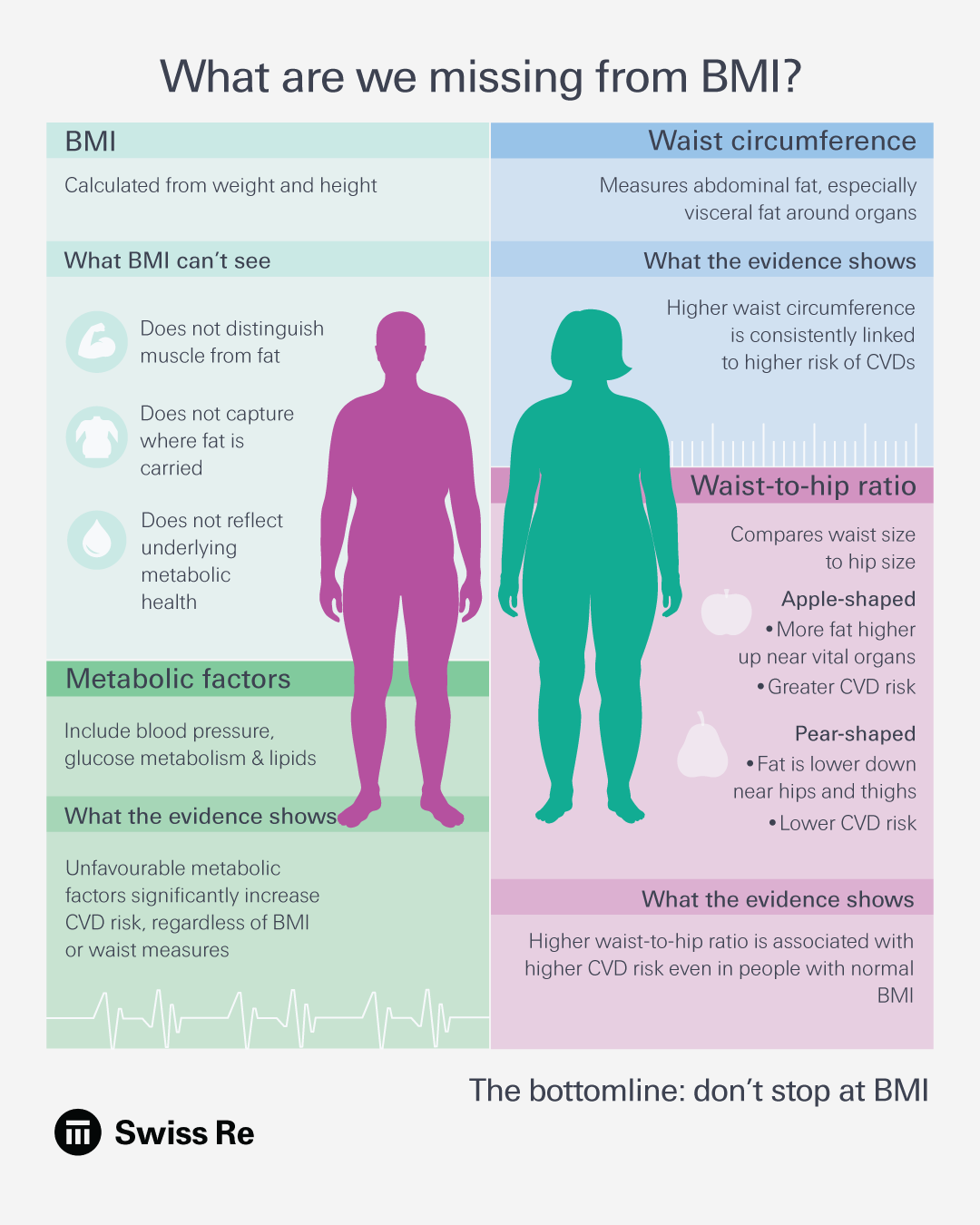
- Waist circumference: This provides a proxy for "central adiposity, or fat carried around the abdomen and visceral fat surrounding internal organs. Visceral fat is not simply stored energy. It is biologically active, releasing fatty acids and signalling molecules that influence insulin sensitivity, glucose and lipid metabolism, inflammation and cardiovascular health.
- Waist-to-hip ratio : This adds a further dimension by taking body shape and fat distribution into account. We can, for example, distinguish between “apple-shaped” bodies and “pear-shaped” bodies. For people with “apple-shaped” bodies, more fat is concentrated around the abdomen and upper body – a pattern associated with greater cardiometabolic risk. Pear-shaped bodies, store more fat around the hips, buttocks and thighs, which may act as a relatively safer store for excess fat rather than accumulation around vital organs. The waist-to-hip ratio helps quantify this difference.
Metabolic health markers: BMI and waist measurements can indicate potential risk, but they cannot tell us what is happening beneath the surface. Blood pressure, glucose metabolism and lipids provide information about cardiovascular and metabolic health that body measurements alone cannot capture. Other measures, such as fasting insulin and HOMA-IR, can provide additional insight into insulin resistance and metabolic dysfunction, potentially identifying emerging risk before it is evident through glucose or HbA1c alone.
These measures are not routinely used in Life & Health underwriting today but may offer a more sensitive view of underlying metabolic risk. We know, for example, that cardiovascular and mortality risk increase further when obesity is accompanied by hypertension, diabetes, dyslipidaemia or insulin resistance.
Looking beyond traditional body measurements and routinely used biomarkers could therefore support a more precise and forward-looking assessment of individual risk. None of these replaces BMI. Together, they provide complementary pieces of the risk picture: BMI tells us about weight relative to height, waist measures tell us more about where fat is carried and how it is distributed, and metabolic markers tell us more about its potential impact on health.
Putting this into practice
Swiss Re's underwriting philosophy already recognises the value of looking beyond BMI. When richer information is available, the Cardiometabolic Calculator can also account for age, blood pressure, lipids and glucose metabolism, helping underwriters differentiate applicants who may share the same BMI but have very different underlying cardiometabolic risks.
In essence, we have absorbed much of the analytical complexity, translating physical and biomedical markers of obesity, where available, to support practical risk assessment. In doing so, Life Guide empowers underwriters to make use of richer data where it is available, and to look deeper where the clinical picture does not align with BMI alone. This ultimately can support underwriters in a more individualised and accurate assessment of risk.
Better underwriting is rarely about discovering entirely new risks. More often, it's about seeing known risks more clearly. In this case the message is clear: don't stop at BMI.
Tags
Contact Author