


Shifting cyber insurance growth into the next gear
Despite a fast-evolving cyber threat landscape, the cyber insurance growth story has continued to slow, with Swiss Re's latest data showing a third consecutive year of rate deterioration and reduced organic growth. So, what is holding cyber insurance back from keeping pace with cyber risk – and what will be needed to help it shift into the next gear for stronger growth?
Article information and share options
Last year, Swiss Re's cyber reinsurance team examined why the double-digit cyber premium CAGR 1 seen from 2017 to 2022 then slowed so rapidly to single-digit CAGR. This latest update highlights the market's underlying conditions, key growth drivers and avenues for future growth.
Global cyber insurance premium by underwriting year (bn USD)
While cyber does continue to prove a compelling business line, with Swiss Re projecting full-year 2025 premium to hit USD 15.6 billion, growth estimates have been revised from 6% to 5% CAGR as from 2023. The ambitious exponential cyber growth forecasts frequently circulated in the industry are unlikely to materialise.
Cyber – a global business line with differing regional maturities
As shown above, North America continues to dominate, commanding 66% of premium share (or approximately USD 10.28 billion).
Europe remains the second largest region, commanding 21% premium share while APAC ranks as the third largest market for cyber premium with a 10% premium share, and the Latam and MEA regions remain small in terms of current cyber insurance premium.
The untapped cyber market growth potential of many economies across both Europe and APAC is evident and promising.
Rate reductions eroding organic exposure growth
The overall growth of the cyber market can be broken down into two main metrics:
- Organic exposure growth (i.e. new customers purchasing policies and existing customers purchasing higher limits)
- Rate growth (i.e. higher premiums for the same limits)
Increased market competition is a key reason why cyber is now in its third consecutive year of rate reductions, as cyber insurance supply continues to outstrip demand. As shown above, this, in turn, is leading to the neutralisation of the positive underlying exposure change seen in recent years by negative rate changes. The increasingly competitive environment has caused further concessions on premium, limits, coverage and cyber security controls.
However, the cyber threat landscape and loss trend environment are continuing to evolve rapidly. Concerns about systemic loss events and rising privacy liability litigation demand caution when it comes to year-on-year premium reductions. The cyber market needs to stabilise at a sustainable rate level to be able to absorb extreme events and to ensure the long-term viability of this business-critical coverage. In parallel, market expansion into new customer segments will help offset the slowdown of organic growth observed in recent years.
Cyber insurance take-up – how the customer base is changing
What percentage of each customer segment is buying cyber insurance?"
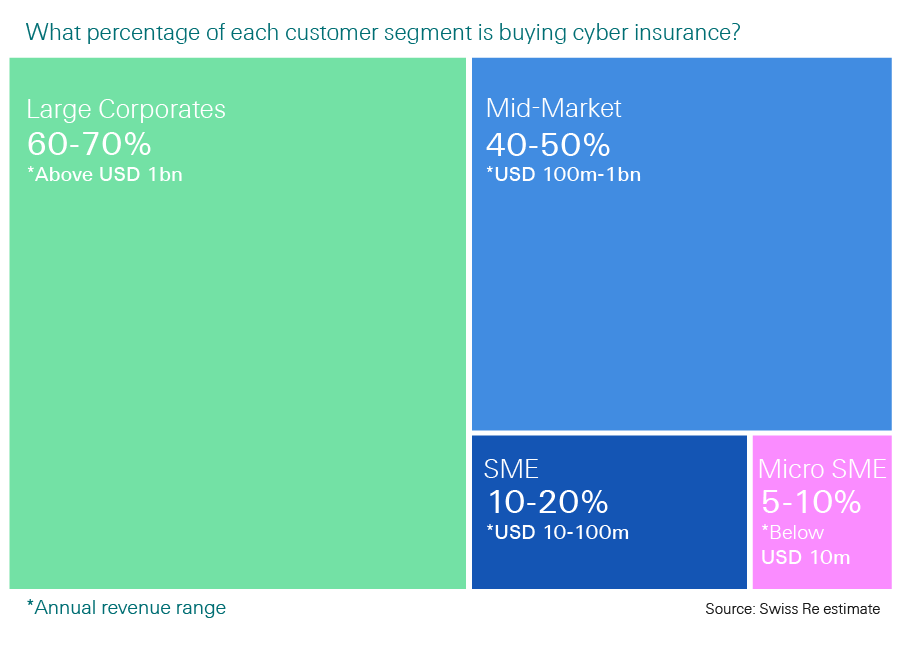
Small and medium-sized enterprises (SMEs) make up 90% of all businesses globally 2 but compared with other segments, they remain massively underserved, according to Swiss Re's estimate of cyber insurance take-up rates.
Helping bridge this SME cyber protection gap requires first recognising the complexity and diversity of this customer segment. Far from being mini-corporates or scaled-down mid-market firms, SMEs have their own distinct characteristics, needs and cyber exposures.
Even among SMEs, distinctions are required. Data from the North American and European markets shows that cyber take-up differs significantly between micro-SMEs (between 5-10% penetration) and SMEs (between 10-20% penetration). The segments also differ in terms of current buying habits, with micro-SMEs tending to buy cyber as a policy add-on while SMEs tend to purchase stand-alone coverage.
Where these sub-segments align is in their limited cyber security know-how, their tight insurance budgets and – perhaps most crucially – their organic growth potential.
Today, on a global basis, SMEs and micro-SMEs jointly account for a 30% share of total cyber market premium (or USD 4.7 billion). They represent an enormous protection gap and, with that, a vast opportunity for the cyber insurance market to target new growth. This could be by attracting new buyers or by upselling existing buyers from add-on to stand-alone coverage. So, what is holding the market back?
Addressing the cyber SME protection gap – five levers for further growth
Addressing the Cyber SME protection gap
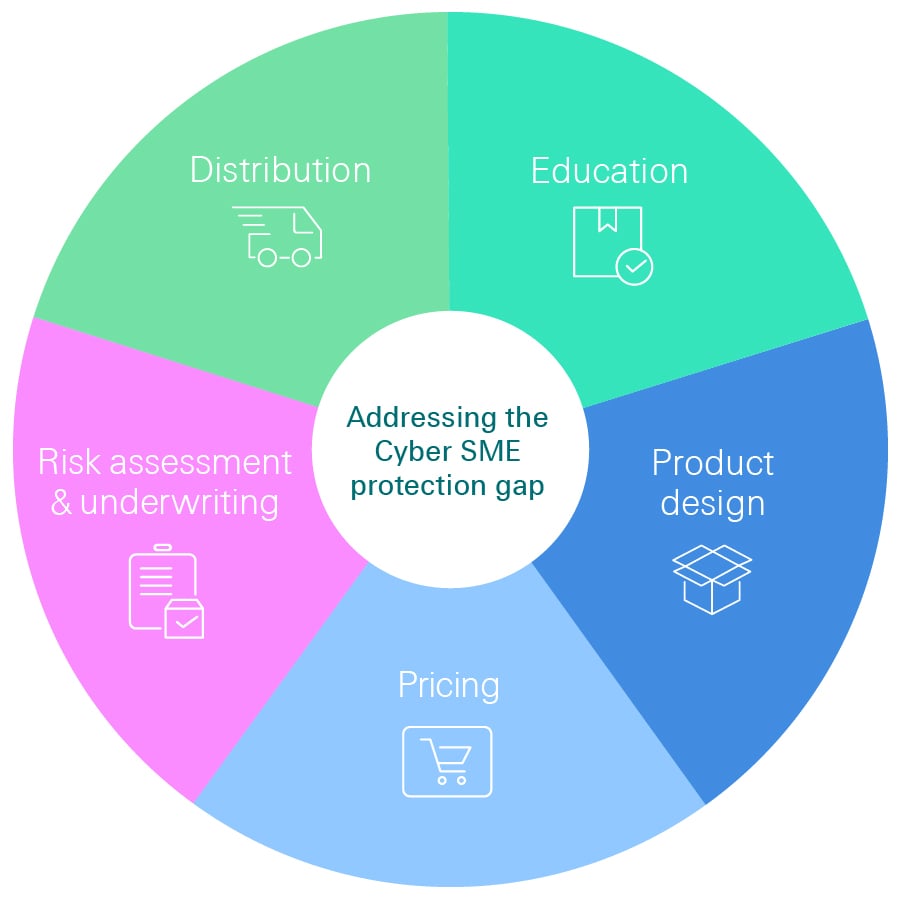
The reasons behind the cyber protection gap among SMEs are multifaceted. As such, the actions required to bridge this gap depend on several factors.
Around the globe, some cyber market participants are successfully accessing market share in the SME segment. While there are regional differences, global analysis by Swiss Re identifies five fundamental growth levers – the right combination of which has the potential to unlock the further growth required to help bridge the SME cyber protection gap.
Education

Education
SMEs often underestimate or misunderstand their cyber risks, believing they are “too small to be a target”, and remain unaware of the benefits of cyber insurance. At the same time, traditional insurance brokers and agents – who operate as trusted advisers for SMEs – can lack cyber expertise and confidence, leaving a gap in distribution and guidance.
Success factors:
- Boost awareness and understanding through targeted cyber risk education campaigns. Equip brokers and agents with training, tools, and clear communication materials, and frame cyber insurance in simple, business-friendly terms.
- Show SMEs how cyber coverage complements rather than duplicates existing P&C policies, making it easier for both brokers and SMEs to see the value and adopt the product.
Education

Product design
Existing cyber insurance products can be ill-suited for SMEs and particularly for micro-SMEs. Many are complex, expensive policies originally designed for large corporates and simply scaled down, leaving SMEs with coverage that does not match their needs or budgets.
Success factors:
- Design dedicated SME-focused products that are simple, affordable, and modular, offering core coverages (e.g. data recovery, business interruption, privacy liability) with optional coverage extensions.
- Embed practical risk management services such as 24/7 helplines and incident response support to address SMEs’ lack of in-house cyber security expertise.
- Use clear, jargon-free policy wording, adapted to local regulations and industry contexts, to ensure accessibility and relevance.
Education

Pricing
SMEs operate with tight insurance budgets and often view cyber insurance as too costly, especially since many do not fully understand its benefits. As a result, cyber coverage is all too often seen as a “nice-to-have” rather than as essential protection.
Success factors:
- Develop and price SME-friendly products by focusing on essential coverage that avoids unnecessarily high premiums.
- Manage costs with lower limits or sub-limits while ensuring pricing remains sustainable for insurers, providing SMEs with stable, long-term access to cyber protection.
Education

Risk assessment & underwriting
Complex and time-consuming risk assessments, particularly questionnaires, which often include highly technical cyber security terminology, can discourage SMEs from purchasing cyber insurance. At the same time, manual underwriting consumes too many resources, driving up costs and making products unaffordable.
Success factors:
- Adopt scalable, tech-driven underwriting models that use automation and risk scoring to streamline the process and keep costs down.
- Simplify questionnaires to avoid complex technical jargon and redundant questions.
Education

Distribution
Traditional distribution models have been designed for large corporates and as a result are too complex and inefficient to scale profitably to SMEs, making it harder to reach this segment effectively.
Success factors:
- Use digital distribution platforms (or APIs to third-party platforms) to simplify the buying process for brokers and SMEs.
- Explore bundling cyber insurance with other P&C products or SME packages to reduce friction and align with SMEs’ preference for one-stop shop solutions.
How reinsurance helps address the SME cyber protection gap
The scale of the SME cyber protection gap is matched by the scale of the opportunity at hand for the cyber market to shake off concerns that a slowdown means stagnation, and to pursue new organic growth avenues. It is important, however, to recognise that as the penetration rate among SMEs starts to increase, that will inevitably bring its own risks.
More SME insureds mean more accumulation potential, and reinsurance is vital in helping manage accumulation exposure. Meanwhile, entering any new customer segment requires access to high-quality and timely data insights, such as those from Swiss Re's Cyber Data Lake. 3
In line with Swiss Re's ambition to be a partner for growth, our regional structure puts our underwriters on the ground with our clients. This proximity allows us to support our clients in understanding and navigating the local nuances of the SME cyber protection gap, and to walk alongside them on their cyber growth journeys.
Cyber insurance growth in the next gear
Cyber continues to offer a compelling opportunity for further growth, particularly in the SME space, outpacing many other lines of business. Realistic growth expectations and a sustainable cyber insurance sector will ensure that SMEs and corporates can be supported and protected by their insurers in the long term, as they navigate a complex cyber risk environment.
References
References
1 CAGR = Compound Annual Growth Rate
2 World Bank Group
3 The Swiss Re Cyber Data Lake is Swiss Re's in-house database of detailed cyber insurance exposure worldwide. It offers a comprehensive view, representing approximately 70% of the global cyber insurance market, making it an invaluable resource for understanding cyber insurance market and loss trends.
References
Disclaimer Statement
1. General Information
The information contained in this document (the “Document”) is provided for general informational purposes only. It is derived from sources believed to be accurate and reliable as of the date of publication; however, no representation or warranty, express or implied, is given as to its completeness, accuracy, or fitness for any particular purpose. No confidential, proprietary, or trade secret information of any third party is intended to be, or has been, disclosed herein.
2. Forward-Looking Statements
This Document may contain forward-looking statements, including, without limitation, statements regarding future business strategies, market developments, growth projections, or financial performance. Such statements are based on current assumptions and expectations that are inherently subject to known and unknown risks, uncertainties, and other factors beyond the issuer’s control. Actual results, performance, or achievements may differ materially from those expressed or implied in these forward-looking statements. Readers are cautioned not to place undue reliance on any forward-looking statements, which speak only as of the date they are made. Except as required by applicable law, the issuer undertakes no obligation to update or revise any forward-looking statements contained herein.
3. Jurisdiction-Specific Compliance
The products, services, or strategies described in this Document may not be available in all jurisdictions and, where available, remain subject to local regulatory approval and applicable legal requirements. Nothing in this Document shall be construed as a representation that any particular regulatory authorization or approval has been or will be obtained in any jurisdiction.
4. Currency of Information
The information set forth in this Document is current only as of the date of its issuance. The issuer disclaims any obligation to update, supplement, or correct this Document after that date except as required by law.
5. No Legal, Financial, or Professional Advice
This Document is provided for informational purposes only and does not constitute, nor should it be construed as, legal, financial, accounting, tax, investment, or other professional advice. Readers should consult with qualified professional advisers, including legal counsel and financial advisors, before making any decision or taking any action based on the information contained herein.
Tags
Contacts

Dani Tobler

Fabian Willi

Stephan von Watzdorf

Brett Nakano
