

Palisades Fire: Examining How Swiss Re's CatNet® and the Bellwether Wildfire Model Can Help Improve Insurer Outcomes from the Next Wildfire Event
Article information and share options
This article was written
By
In January 2025 multiple fires ripped through neighborhoods in the greater Los Angeles area, destroying businesses, homes and livelihoods. The two most destructive events, the Palisades Fire and Eaton Fire, were unique yet fueled by conditions all too familiar to California residents: the Santa Ana winds, hot and dry conditions, and abundant vegetation.
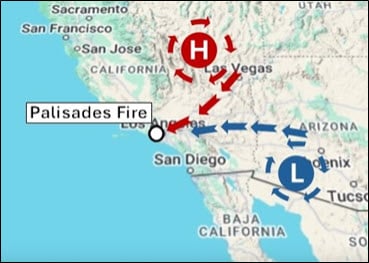
The fires were unique not only because of the Santa Anas, but also because the winds were supercharged by a low-pressure system generating speeds of 60-80 mph. Combined with single digit humidity and dry vegetation that had grown dense from two years of above normal rainfall, this was a perfect storm in which even a small spark can trigger a blaze that challenges the most aggressive and strategic firefighting response.
Santa Ana winds kick up when a high-pressure system over the inland desert produces high-speed winds
Swiss Re's CatNet® has the wildfire insights you need
The increasing threat of wildfires is a fact of life. Due to the complexity of modeling all the variables that contribute to wildfire, an AI-first approach seems to be the only way to keep up with this peril that’s evolving fast. Enter Swiss Re’s natural hazard atlas CatNet®, which features a Wildfire Probability layer that uses advanced machine learning. The layer is available for Canada and the contiguous United States and will soon be available in Australia, and it complements the global wildfire layer from Swiss Re.
The Wildfire Probability layer in CatNet® is powered by an advanced machine learning model developed by engineers at Bellwether, a team at x, the moonshot factory, which is the innovation arm of parent company Google. It evaluates nearly 600 parameters across weather, vegetation, terrain, fire history, and human factors. Using the Wildfire Probability layer in CatNet® enables insurers to make more informed risk selection, underwrite with greater accuracy and set pricing that reflects the risk.
The machine learning model from Bellwether is updated quarterly to respond to the dynamic environmental and human patterns of wildfires. As wildfires evolve in response to a changing planet, the model learns from constantly changing inputs. Unlike most wildfire products, the model provides the probability a wildfire will occur in the next year or in the next five years. This gives underwriters confidence to make short-term and longer-term decisions. The one-year probability is useful when deciding whether to write or renew a policy using the most advanced view of current conditions and the five-year probability is useful for setting more stable pricing based on a longer-term view of the wildfire probability.
What can Bellwether teach us about the Palisades Fire?
Similar to an analysis conducted on the Mountain Fire in Ventura County, we wanted to see what the Bellwether model could teach us about the Palisades Fire. Our analysis compared lost structures in the Palisades Fire with an example portfolio of 12,000 randomly sampled residential properties across California in order to understand how well the Bellwether model predicted the probability of a wildfire inside the Palisades Fire perimeter and how these probabilities compare to other properties across the state. As an insurer, it is important to understand how the risk of individual property compares with the larger market and with other risks in one's portfolio.
Lost structures in the analysis come from reports issued by Cal Fire on the post-event condition of every structure; we defined a lost structure as having 25% or more damage. We see this as a conservative view when considering smoke damage might constitute a total loss even if physical structure damage is less than 25%.
For both the Cal Fire data on lost structures and the sample California portfolio, we assigned the one-year and five-year wildfire probabilities from Bellwether. Coincidentally the data used in the model had been refreshed just days before the fires started, resulting in wildfire probability predictions from Bellwether reflecting the situation on the ground when the fires started. To help estimate expected losses, we obtained market value information from a single source for all locations for a consistent view of property value, or Total Insured Value (TIV).
Key findings on the Palisades Fire
- 0 lost structures in Low or Very Low categories
- Lost structures were 4x or 330% more likely to be in High to Extreme categories compared to the state average
- Expected losses for lost structures were 10x or 900% higher compared to an sample California portfolio
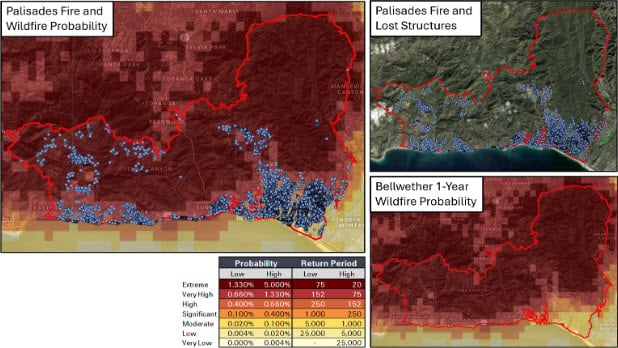
Assigning each structure to one of the Bellwether wildfire hazard categories, we found that structures lost in the Palisades Fire were four times or 330% more likely to be in a High, Very High, or Extreme category than the California average. These three wildfire categories represent a wildfire probability of 0.4% or greater, or a 250-year return period or more frequent. The most extreme case is a lost structure with a 23-year return period! It is also worth noting that none of the lost structures were in the two lowest wildfire categories of Low and Very Low, indicating that Bellwether did not miss any of these risks.
Looking at expected losses given wildfire probability, we found structures lost in the Palisades Fire had ten times, or 900%, higher modeled losses compared to the state average. The average market value of lost structures is $2.8 million compared to $1 million in the example California portfolio. Controlling for this difference in average market value, expected losses for the lost structures is still much higher than the state average.
A comparison of the Bellwether and the actual fire footprint shows an extraordinary degree of congruence. Source: CalFire and Bellwether
Meeting the challenge of modeling wildfires
We are often asked how the Bellwether model predicts where fires will ignite. Predicting ignition requires making assumptions of ignition triggers and locations; many models include ignition drivers like roads or populated areas. The Bellwether team found that an overreliance on such assumptions can miss wildfires in remote areas triggered by, for example, lightning or electrical lines. The power of Bellwether's approach is to consider the potential of ignition anywhere. The model's risk scores implicitly consider ignition probabilities encompassing all human and natural sources, including electrical sparks, lightning, and human causes. This approach allows the model to better represent the fact that around 16% of wildfires are started by non-human sources resulting in almost 60% of total burn area in the coterminous United States.1
Insurers are increasingly reevaluating their wildfire exposures and often seek a second or third view of wildfire risk given the variability found in wildfire models. In emerging wildfire-prone areas such as Canada the explosion of destructive wildfires has outpaced the ability of insurers to adequately evaluate the risk. In mature wildfire-prone markets like California or Australia, a common challenge is finding analytical tools that can accurately quantify the risk. There are numerous wildfire hazard maps and probabilistic models in these mature markets; however, they often use a limited number of variables, which leads to an incomplete view of wildfire risk.
Even seemingly advanced AI or machine-learning models can be limited by the amount and quality of training data used. This can result in "overfitting" – where the model can only predict events on which it has been trained, which limits the ability to respond to increasing frequency and severity. The Bellwether tool has been specifically designed and tested to respond to these "out-of-sample," or historically unprecedented events. Additionally, it continuously learns and evolves from events with every quarterly update.
How can Swiss Re help?
Swiss Re can help identify at-risk locations with tools like CatNet®. Strategies can be devised to set adequate premiums aligned with the probability of wildfire. We can help develop updated underwriting guidelines that work in combination with the Bellwether Wildfire Probability data in CatNet® to help ensure future wildfire-prone risks are not added to an insurer’s portfolio as new business is written. And we can evaluate accumulation risk at a portfolio-level or at the point of quote so no single event impacts performance.
These are all useful defensive strategies, but winning outcomes require good offense as well. Swiss Re can help identify targeted new business opportunities in challenging wildfire-prone markets so insurers can grow their portfolios responsibly and profitably.
Using the Bellwether model, we confirmed that the Palisades Fire occurred in an area exposed to high wildfire hazard. Like Smokey Bear says, "only you can prevent forest fires." Only your organization can prevent wildfires from impacting your performance. We think the Bellwether wildfire model available in CatNet® is a step change in wildfire risk assessment and invite you to see for yourself. Contact us to discuss how AI-powered machine learning of continually updated robust data can help you improve your organization’s performance.
Tags
Contact Do you have any questions?

CatNet® office
Your locations, our data, smart results.