

Accelerated Underwriting in Focus
The state of AUW in the life insurance industry and key considerations for the future of underwriting
Article information and share options
This article was written
By
Executive summary
- Swiss Re has developed an Accelerated Underwriting (AUW) study based on over 37 000 random holdout and post-issue audit policies.
- Industry mortality slippage is observed to be around 15%. Individual AUW program results vary greatly from around 5% up to over 30% slippage.
- Acceleration percent is a key driver of mortality slippage. In general, programs that accelerate a larger percentage of eligible applicants tend to have higher slippage.
- As life insurance companies have pushed their acceleration percentages higher, a modest uptick in mortality slippage is observed in recent years.
- Build, tobacco, substance abuse, depression and anxiety, and blood pressure are some of the most common conditions resulting in inaccurate AUW risk class decisions. Tracking what is being missed by an AUW program is an important insight that companies should be considering.
- Random holdouts and post-issue audits are both effective ways to evaluate the performance of an AUW program, but they catch different things and tell different stories.
- Robust record keeping is necessary to set ourselves up for future AUW insights.
Introduction
How are Accelerated Underwriting programs performing? This is the million (or billion!) dollar question we’ve been asking ourselves since the dawn of these programs over 10 years ago.
Let’s start by defining “accelerated underwriting.” Accelerated Underwriting (AUW) is the waiving of traditional labs and paramedical exams for a subset of applicants that meet certain qualifications to make quicker and less invasive offers to insurance applicants, often at the same price point as full underwriting (FUW). Essential to this definition is not everyone gets to go down the AUW path. There is a threat of fluid testing that has a known sentinel effect and is key to the mortality implications. Accelerated underwriting should not be confused with automated underwriting. Whereas accelerated underwriting is focused on fluids vs non-fluids, automated underwriting is focused on engine decisions vs human decisions.
The ultimate goal to understanding AUW performance is having ample claims data from which to study mortality experience. As an industry, we are getting closer every day, but we’re not there yet. Credible claims data is still developing, but that’s not all. Some of the industry still struggles to identify AUW policies in admin and claims systems. We also have the challenge of COVID-19 disrupting our traditional mortality studies and making it difficult to isolate AUW insights. In the presence of these challenges, the industry has turned to proxy methods of monitoring AUW, namely random holdouts (RHOs) and post-issue audits (PIAs).
The aim of RHOs and PIAs is to compare a company’s AUW decision to what it would have been in a FUW environment. If the 2 risk classes match, then AUW is considered to have made an accurate decision. However, if the AUW risk class is better than the FUW risk class, the AUW process missed something in the underwriting, and this leads to what’s called “mortality slippage”. In other words, less premium is being collected (i.e. the better AUW risk class) relative to the overall level of risk (i.e. the FUW risk class).
By aggregating and anonymizing RHO and PIA data from around the life insurance industry, Swiss Re has been able to gather incredible AUW insights. We enjoy sharing these insights with our client partners, but this is often only the beginning of the conversation. As your business partner, our goal is to walk alongside you, addressing your challenges, listening to your ambitions, and helping you work towards a more successful AUW program.
Swiss Re study snapshot
- Over 25 life insurance companies
- Over 37 000 audited AUW policies
- Approximately half is confusion matrix data that only offers a comparison of AUW risk class and FUW risk class.
- The other half is seriatim level data that offers additional insights into pockets of business that have more mortality slippage than others.
- Relative mortality assumptions are unique to each life insurance company. We recognize different companies have different mortality by risk class, so we’ve captured that by leveraging our reinsured mortality experience. Aggregate mortality for standard or better classes is normalized to 100%.
- As an example, individual risk class assumptions may look something like this:
– Super Preferred NT = 75%
– Preferred NT = 90%
– Standard Plus NT = 105%
– Standard NT = 120%
- Substandard is assumed to have a 25% load per table. For example, table 4 would be 200% relative risk.
- Decline mortality is a key assumption. We’ve assumed declines have 500% relative mortality.
- Tobacco users are assumed to have 275% relative mortality, but this would get split between preferred and standard tobacco.
Mortality slippage
The mortality slippage derived from the differences in AUW and FUW risk classes is approximately 15% overall. However individual companies see drastically different experience depending on the characteristics of their AUW program. Many AUW programs’ slippage falls in the range of 7–13%, but there are also many more programs with slippage in the range of 20–30% with some going even higher than 30%.
One of the biggest drivers of mortality slippage is the number of declines that slip through AUW. In our study, 1.8 of every 100 AUW policies are ones that should have been declined or postponed. These policies alone make up 40% of the overall slippage (6% of the 15%).
The other key contributor of mortality slippage is nondisclosed tobacco users which we are unable to catch in AUW. Our study indicates 2.1 of every 100 AUW policies are ones that should have gotten a tobacco offer but in fact got nontobacco through AUW. These policies make up about 20% of the overall slippage (3% of the 15%).
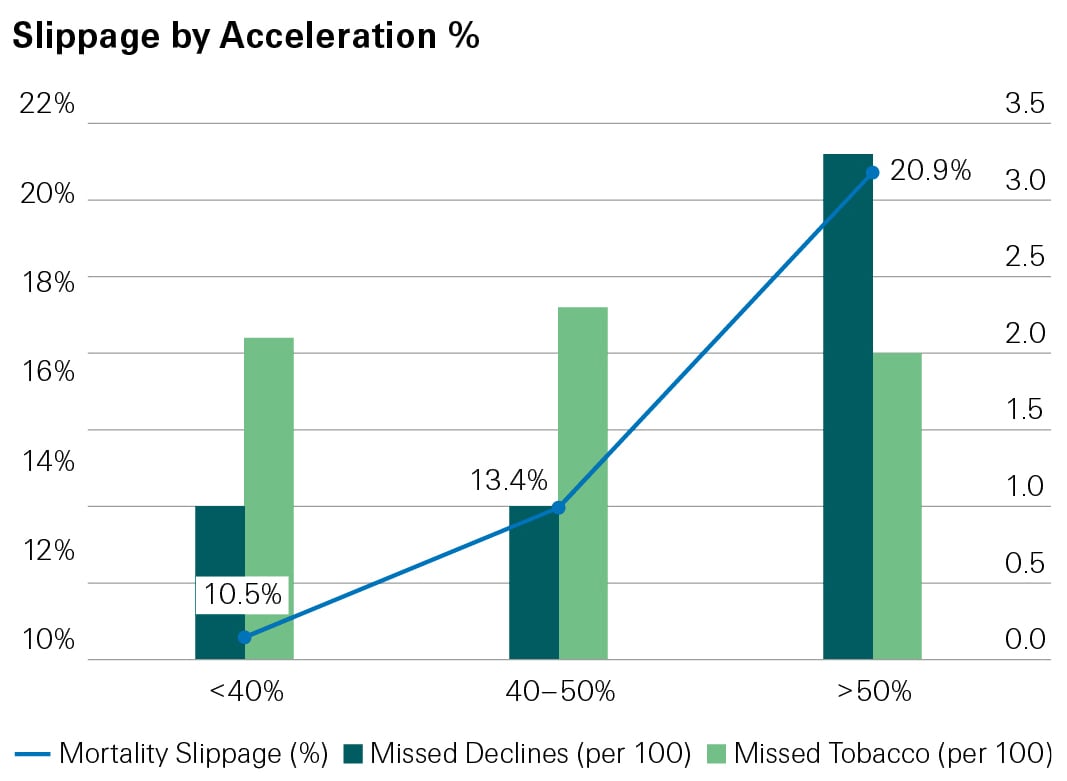
There are many things that can contribute to an AUW program having higher slippage than others —underwriting tools used, target market, product type, handling of “no hits” — but one of the key decisions a company must make is how strict they are going to be regarding who qualifies for AUW. Another way to say this is, acceleration percent. Acceleration percent is defined as the number of people who successfully qualify for AUW divided by the number of people originally eligible for AUW. In general, the higher the acceleration percent, the higher the mortality slippage. This is illustrated by the snapshot below where the average AUW program that accelerates more than 50% of people is exhibiting mortality slippage double that of programs accelerating less than 40%. In general, it is the higher prevalence of missed declines that is contributing to the higher slippage.
Slippage by acceleration
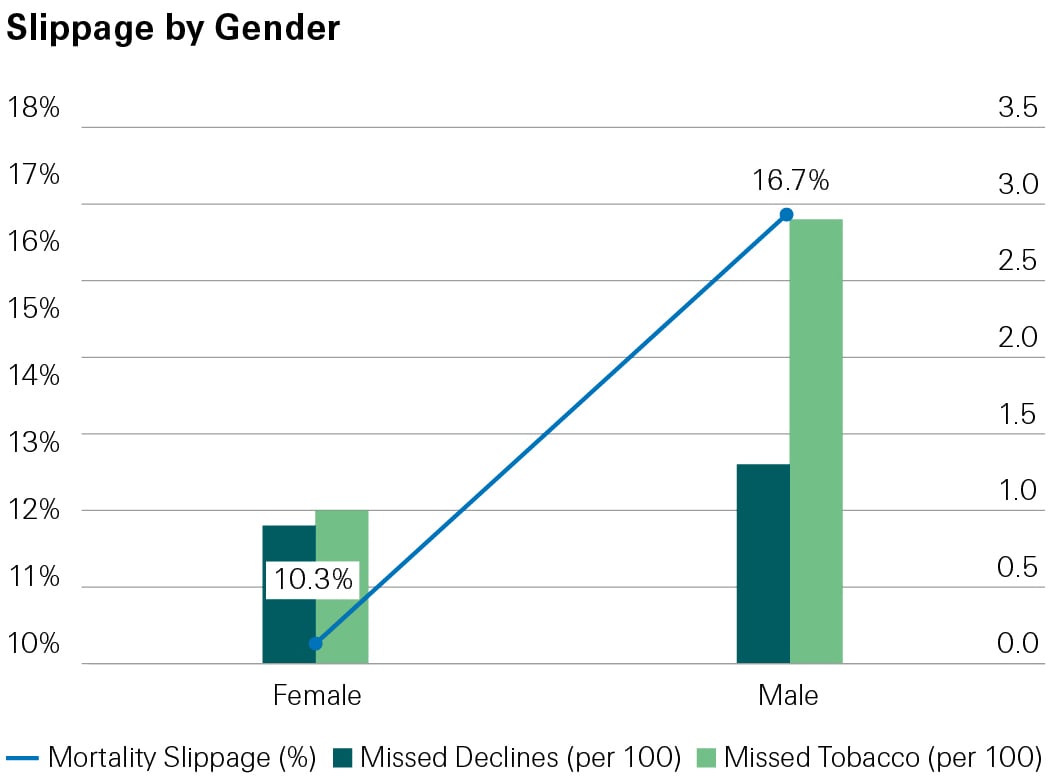
Another glaring trend is that males tend to have significantly higher slippage than females (16.7% vs 10.3%). There are a couple of theories behind this trend. The first is due to medical footprint. If males, especially younger males, are not as prone to go to their annual physicals, there may simply be less data on males to evaluate in AUW. The second theory is males may simply be more likely to nondisclose on their application. Part of this is evidenced by males having materially more missed tobacco than females (2.9 vs 1.0 cases per 100), but part of this too may be that males have a higher propensity of tobacco use.
Slippage by Gender
It is important to acknowledge how we as an industry have been doing over time. One would think that as tools have gotten better and companies have gotten more familiar with AUW programs, we should be seeing improved results year over year, but this is not necessarily the case. In fact, we’ve seen worsening of results in the last few years, and we believe there are two primary drivers.
- We’ve already seen how acceleration percent can lead to higher slippage, and over time, companies have gradually pushed their acceleration percents higher to keep up with competition, to appease distribution, and simply to get more use out of their AUW programs. As a result, we are seeing increasing slippage numbers.
- Customers and agents are becoming more aware of AUW programs. If an application is completed with the expectation of not having to go through fluid testing, this opens the door for anti-selection.
Slippage by Year
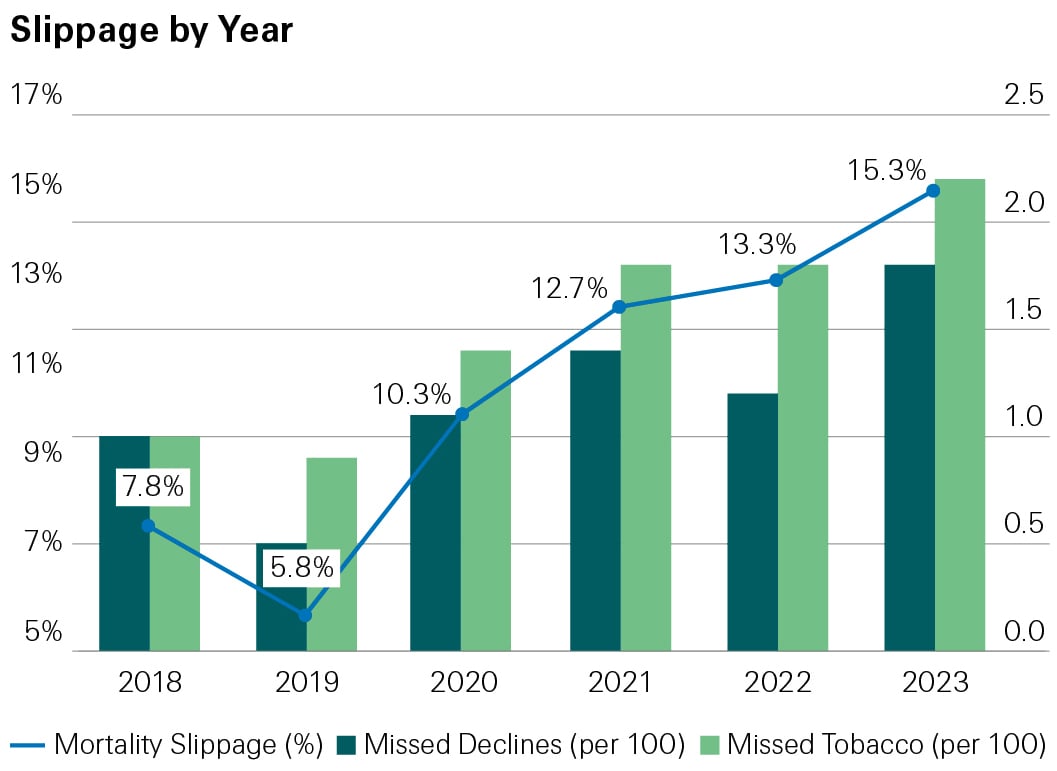
It should be noted that it is a bit of a challenge to present year-overyear AUW results while controlling for various factors. Namely, the ‘by year’ data has been pared down to only companies for which we had policy level data including date and of those, only companies that had an appropriate cross section of years represented. For example, we excluded a handful of companies where we only had 2022 and 2023 results as the later years would be skewed higher or lower not because of AUW trends but because of which companies were included. As a result, the ‘by year’ subset of data has less than half the total number of companies represented. The keen eye will notice that the weighted average slippage in the ‘by year’ graph would be something less than the 15% overall slippage noted above, and the reason for this is because we are using only a subset of the overall study data.
Reason analysis
Many companies stop their AUW analysis at simply comparing AUW and FUW risk class decisions, but there is a lot more insight that can be gleaned if they’re willing to go deeper. It’s important to know when a risk class decision would have been different, but it’s also valuable to know why that decision would have been different. What impairment was not disclosed and not uncovered in the accelerated underwriting process?
Whereas our AUW study consists of over 25 companies providing AUW vs FUW decisions, only 10 of them also include reasons behind the difference in decisions, and the number of policies falls from over 37 000 to approximately 12 500. Our team has categorized around 2 000 reasons into about 20 buckets, which includes things like tobacco, build, blood pressure, cholesterol, depression and anxiety, substance abuse, etc. There is also a fairly large bucket called “unable to determine.” This is predominantly made up of nonspecific reasons such as “medical history” or “lab finding” which we were unable categorize into the other buckets. “Unable to determine” also serves as a catch-all “other” category.
Conditions missed by AUW
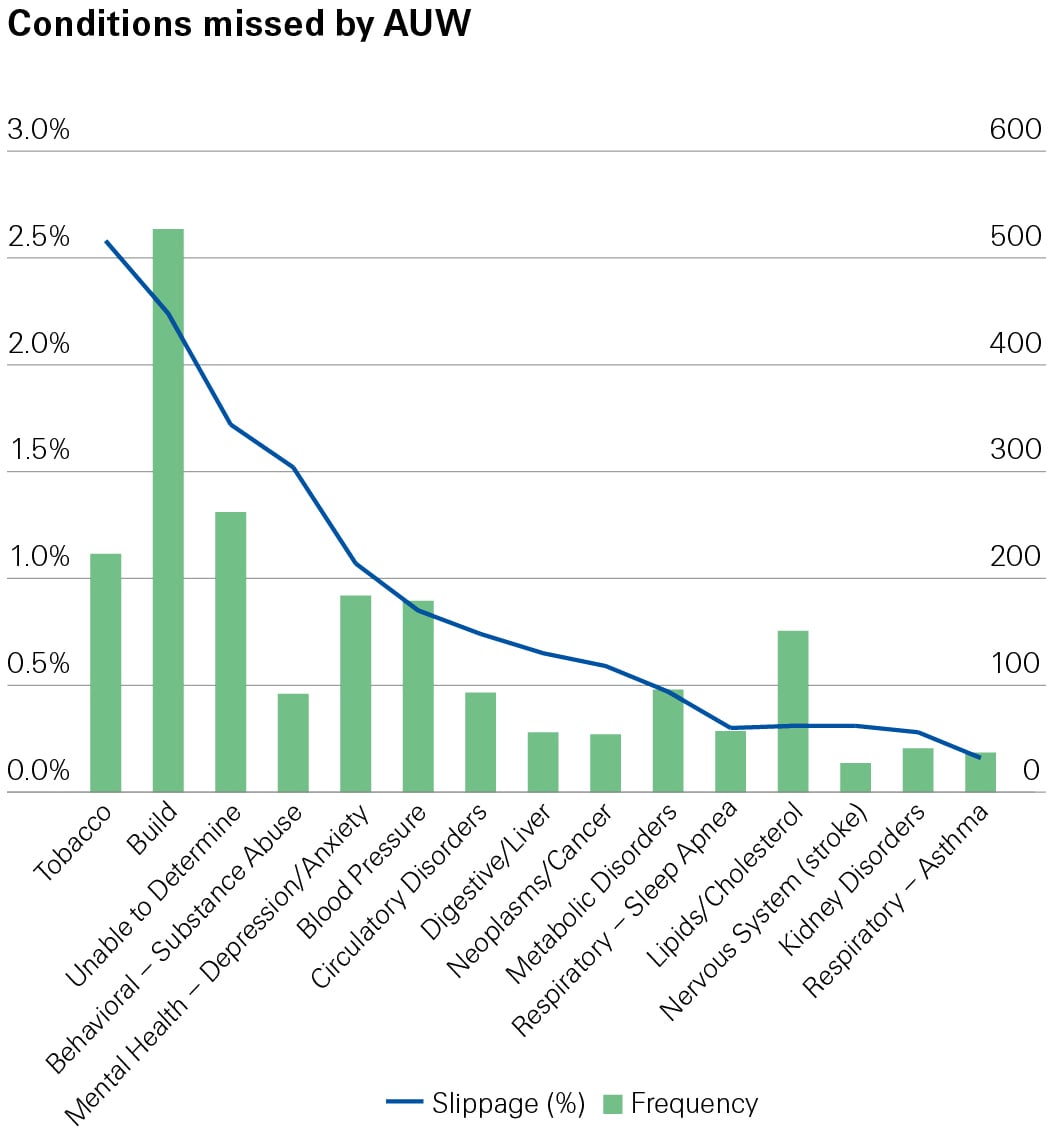
It probably comes as no surprise that build is the most commonly cited reason driving differences in AUW risk classes, with roughly one quarter of all AUW differences noting a build discrepancy. This amounts to about 2.3% (of the total 15%) mortality slippage coming from build. The next highest frequency reasons observed are “unable to determine”, tobacco, depression and anxiety, blood pressure, and lipids/cholesterol. When we marry the frequency of each condition with the severity, we can see things like tobacco taking the top spot in terms of highest contribution to overall slippage, 2.6%. Something like lipids/cholesterol is seen quite commonly, but often isn’t a severe mortality impact and only contributes 0.3% to the overall slippage.
Substance abuse is something that stands out as being the fourth biggest driver of mortality slippage while only being the eighth most common reason. This implies that when substance abuse is identified as something being missed in AUW, it’s usually responsible for a significant difference in risk class, often being an application that should have been declined.
To this point, we’ve talked a lot about random holdouts (RHOs) and post-issue audits (PIAs) and basically lumped them together as similar means of monitoring the performance of an AUW program. That’s true; both are effective ways to gain valuable insights, but it’s important to recognize that the insights you get will be different depending on whether you are doing an RHO or a PIA.
In some ways, the RHO is the preferred method of understanding an AUW program because it is the best applesto-apples comparison of an AUW decision to the FUW decision. PIAs on the other hand often involve reviewing an Attending Physician Statement (APS) or sometimes an Electronic Health Record (EHR), both of which provide different information than traditional blood and urine tests. Depending on the APS, you could be getting more information than traditional fluid testing, so if you’re using this as your benchmark for comparison, you could be overly penalizing your AUW program. What it all boils down to is that RHOs and PIAs are going to catch different things.
In our ~12 500 policy study of AUW reasons, 34% are RHO and the other 66% are PIA. If we look at each reason by its split of RHO to PIA and compare it to the overall 34%/66% split, we can see what is more likely to be caught from an RHO vs an APS. Things like build, blood pressure, cholesterol, liver disease, and kidney disorders stand out as conditions that are disproportionately more likely to be caught via an RHO, and this makes sense. These are things we test for in the blood and urine samples. On the other hand, things like depression and anxiety, metabolic disorders, heart conditions, substance abuse, and stroke are conditions that are caught more frequently in an APS.
Frequency of Reasons - PIA vs RHO

Implications on pricing assumptions

So, you’ve done the analysis and calculated your RHO/PIA mortality slippage to be a certain percent. Does this mean you should apply a load equal to that percent in your AUW mortality assumptions? Unfortunately, it’s not that simple. There are several considerations when translating RHO/PIA slippage to AUW pricing assumptions.
RHOs may understate the true mortality slippage for a couple of reasons. “Reverse misclassification” is a term used to describe cases when AUW gives someone a worse decision than they would have gotten through FUW. For example, a person that is healthy enough to qualify for preferred from a FUW perspective, may end up getting a standard offer through AUW. In this case, you’re collecting more premium on the individual than necessary, which comes through as negative mortality slippage, effectively lowering the assumed slippage on the block. There is nothing wrong with this logic except that people who are otherwise healthy and get a less-than-ideal offer are probably not going to purchase and will move on to the next insurance company that will give them a preferred class. In fact, our study data shows very few reverse misclassifications in PIA data, and the reason is because PIAs are only done on policies post-issue. It is assumed that most of the reverse misclassification policies simply walk away, so be careful how much of this negative slippage you let come through in your calculations. For our study, we made the decision to dampen the reverse misclassification policies seen in RHOs. The second reason RHOs may understate the true slippage is due to withdrawals upon being selected for the RHO. Some may back out of the process due to the inconvenience of it, but others will back out to avoid being caught based on what they [non]disclosed on the application. We’ve seen RHO withdrawal rates from 10% to well over 30%, so it is important to monitor your company’s experience.
PIAs could also understate the true mortality slippage. PIAs are less likely to catch small differences in things like blood pressure and cholesterol that help stratify the preferred classes. Our study data shows that PIAs also catch fewer smokers than RHOs. Finally, APS and EHR hit rates skew toward people that go to the doctor more often, and there are known risks with insuring individuals that do not keep up with annual checkups and routine tests.
On the flip side, PIAs can overstate the true mortality slippage because they may reveal conditions and impairments that wouldn’t necessarily have been caught from traditional blood and urine testing. In some ways, an APS can be stronger than what would have been done with fluids, and thus PIA results could overstate mortality slippage.
It’s important to recognize that RHOs and PIAs grade the AUW decision through a medical lens only. It does not account for any socioeconomic benefits of the people in the audit population. If a particular AUW program utilizes a credit and/or lifestyle-based tool in order to triage someone into or out of the AUW path, it’s important to acknowledge that all of the people that are now eligible for the RHO or PIA are people that exceeded the predetermined threshold to qualify for AUW. Thus whatever amount of value you give to passing that threshold will help reduce the calculated slippage from the medical-only view.
As a quick aside on the topic of credit and/or lifestyle-based tools, it’s important to also recognize the impact they could have on the portion of people who get kicked out of the AUW path and go to FUW. Traditional fluid testing also looks at mortality risk through a medical-only lens. It does not directly account for the fact that these individuals have worse scores that got them kicked out of AUW in the first place. As a result, the fully underwritten population of lives could see elevated mortality.
Other considerations for applying slippage calculations to pricing assumptions include whether to use a single number in aggregate or to vary it by risk class, gender, or any other attribute. The number of audited cases and overall credibility of the study should also be considered, especially as you start to slice it more granularly. Finally, the grading of AUW-specific assumptions should also be considered. In general, the AUW mortality slippage factor should be consistent with the mortality assumption that was used to develop it. For example, if the risk class assumptions were based on 90-year present value mortality, the resultant slippage calculation may be appropriate for a similar duration. If the underlying mortality was based on a 10-year present value, the resulting slippage calculation may only apply for 10 years before an appropriate grade off pattern may be used.
AUW tracking best practices
The insurance industry is on an AUW journey, not only with regard to the AUW path, underwriting tools, and automation efforts, but also the tracking, monitoring, and gathering of insights on each of these things so we can feel confident about the actions we’re taking and iterate as necessary. I view our monitoring journey like a pyramid that we should be striving to climb our way up to unlock better insights.
At the most basic level, we can understand how AUW is performing by keeping an eye on our distributions. If historically we had 30% of applicants getting a Super Preferred NT offer, but with AUW it’s 50%, this would be a red flag. Similarly, if we’ve seen a material reduction in tobacco offers being made, it’s probably not because there are fewer tobacco users applying for insurance.
The next level up of AUW monitoring is evaluating RHO and PIA data, and this is where most of the industry is currently. As discussed, there are even different levels within this slice of the pyramid, from simple confusion matrices, to seriatim results that allow us to drill into trends by gender, age, face, etc., to layering on reasons underlying the risk class decisions.
The third level builds upon level 2 by including detail around what business is actually placing and whether or not it is sticking around. With RHO results for example, those insights come at the time of underwriting, and that by itself gives no indication of what is actually hitting the books. As far as persistency, we know that our mistakes are the most likely to stick around, so if we think AUW has a certain impact at time 0, what is the ongoing impact as time progresses?
Finally, the pinnacle that we’d like to reach is how all this impacts our true mortality, i.e. claims experience. It takes not only time for claims to come in, but it takes extra focus on tracking and reporting of AUW in order to connect the experience back to the underwriting journey. That tracking and reporting needs to start today so that we can extract insights in the future. The following is a list of data elements that should be collected today in order to support robust analysis of the future.
- Underwriting path
– AUW
– Kicked out
– Not eligible
– Potential middle path leveraging digital health data - Driver of UW decision/path
– Which tool identified the thing that kicked them out?
– What was disclosed on the part 2, and how did it compare to the database checks? - Engine decision vs human touch
- AUW forensic audit findings
– RHO vs PIA
– Conditions missed by AUW
– Random vs targeted - Third party tool mortality scores (including no hits)
- Important to include not only issued business but all applications (decline reasons matter)
Someday we will be looking back hoping to understand the performance of an AUW program and the protective value of each of the tools being used. Without adequate data, we will be unable to extract the desired insights. The list above will be a good starting point to put yourself on a path to a successful and insightful future.
Mortality pyramide

Audits are no light undertaking, but they are necessary. RHOs impact the applicant experience and require underwriters’ time to sort through the extra data and do the comparison. PIAs are better for the applicant experience but can be costly and time consuming to evaluate. Companies should be randomly auditing a portion, usually 10%, of AUW policies so those learnings can be applied back to the remaining 90% not getting reviewed. Some companies also employ targeted audits where they pull additional records on subsets of the business known to have elevated slippage. The intent is not to apply learnings back to the unaudited portion, but rather to help protect the business coming on the books, which is why random and targeted audits should be tracked separately. Some companies are turning to solutions like Swiss Re’s Underwriting Ease to make sorting through medical records and EHRs easier. By giving a single highlighted view of all risks needing assessment, Underwriting Ease lets underwriters make accurate, consistent assessments in half the time. This is helpful not only during the application process but also adds efficiencies to the AUW post-issue audit process as well.
Present and future trends
Gone are the days of binary — you’re in or you’re out — AUW programs. Underwriting paths are getting more and more sophisticated, trending towards personalization. It used to be easy to depict underwriting paths with a flow chart. One box of eligible applicants gets split into two boxes, those accelerated and those kicked out, and that was it! The flow is getting ever more complicated with a common practice now being a ‘middle path’ where a clinical lab history, an EHR, or an APS may be pulled prior to seeking fluid testing on an individual. We also see instances of these tools and/or medical billing records being required to support an AUW decision at the higher ages or face amounts. Some companies are even dabbling with the concept of smart ordering, whereby the underwriting journey and tests will vary from person to person based on their part 2 or their early data pulls. This creates a unique and cost-effective experience that is appropriate for the specific individual.
AUW programs have historically been designed with the ultimate goal of getting an AUW decision to match the FUW decision, and as discussed in this paper, much of the early AUW insights come from comparing these decisions. This method is good, but it’s not perfect because it considers the FUW decision the single source of truth. In some ways, it’s helpful to do this since that’s what we’re familiar with and that’s what our historical mortality assumptions are based on, but in other ways, operating under this view alone can limit innovation. How do we progress and move forward if we consider past actions as the perfect solution? It is important to recognize this limitation in the work we do. As underwriting sources, predictive models, and mortality scores become more sophisticated, companies will be targeting mortality outcomes, not matching FUW decisions. It remains to be seen whether this is used to do a better job of classifying lives into our traditional 3 or 4 non-tobacco and 2 tobacco risk class structures, or if some companies will start creating finer risk class buckets.
The interplay between acceleration and automation should not be overlooked. Similar to the pressure to accelerate more business, companies are also under pressure to automate more business. We certainly believe in the power of automation using an advanced platform like Swiss Re Magnum and working with risk experts to build appropriate rules, but there will always be a place for underwriters too. Underwriting Ease is a good example of enabling underwriters to use technology in a way that increases the efficiency of their work. It would be concerning if the desire for an instant, non-invasive offer took priority over getting to accurate risk decisions. Automating what we can and streamlining the rest is an appropriate place to go in the near future.
We’ve come a long way in AUW, but there is more work to be done. I’m encouraged by what we’re doing as an industry and hopeful about the future. We’re headed in the right direction to get life insurance into the hands of more consumers. We just need to be wise about where and how we deploy the latest innovations, and we need to collect the right data that will allow us to know what’s working and where we need to improve. At Swiss Re, we appreciate the opportunity to be your partner and collaborate on your journey to bring the future of underwriting closer to today.
Contact Author
