


Rethinking Alzheimer's disease
Could brain metabolism hold part of the answer?
This article was written by John Schoonbee
Summary
Alzheimer's disease (AD) is associated with reduced brain glucose metabolism, while ketone (energy molecule derived from fat) metabolism appears relatively preserved. Increasing blood ketones can therefore provide the brain with an additional energy source. Small scale human studies suggest possible cognitive or functional benefits, but whether this alters the underlying disease is unknown.
Current state of Alzheimer's disease
Anyone who has cared for a loved one with dementia, or supported someone through their journey, will understand the profound emotional and personal challenges that often accompany this devastating disease. Globally, approximately 57 million people were living with dementia in 2021, with almost 10 million new cases annually. The WHO estimated the global cost of dementia to be USD1.3 trillion in 2019, with roughly half of that burden attributable to informal care1. Alzheimer's disease accounts for an estimated 60-70% of dementia cases, making it by far the largest component. Collectively, they are now the fourth leading cause of death in high-income countries2.
In the United States, the 2026 Alzheimer's Association figures estimate:
- 7.4 million people aged 65 or older have Alzheimer's dementia3.
- 19.6 billion hours of care - provided by unpaid caregivers in 2025, valued at roughly USD 446 billion3
- USD 400 billion + - healthcare and long-term-care spending attributable to Alzheimer's and other dementias in 20263.
We know many of the risk factors associated with an increased risk of Alzheimer’s disease and dementia including social and cognitive factors such as uncorrected hearing and vision loss, social isolation, lower educational attainment and depression. In addition to these, physical health factors such as hypertension, diabetes, obesity, physical inactivity, smoking, traumatic brain injury, excessive alcohol consumption, high LDL cholesterol and air pollution are also associated with an increased risk.
How these clusters of risk factors interact amongst themselves, and their relationship to the development of Alzheimer’s disease, is still under investigation. Some of these factors and diseases may be bidirectional or non-causal. For example, a brain capable of learning multiple languages may inherently have greater cognitive reserve or other characteristics that protect against dementia; it does not necessarily follow that actively learning another language later in life will reduce the biological risk of developing Alzheimer’s disease.
View Summary
Mild cognitive impairment (MCI): Objective cognitive decline beyond normal ageing, with independence in everyday activities largely preserved. MCI has multiple possible causes and does not necessarily indicate Alzheimer’s disease.
Alzheimer’s disease: A neurodegenerative disease characterized biologically by the hallmarks of amyloid and tau pathology on the brain, which can be present before symptoms and progressively lead to cognitive and functional impairment.
For more than two decades, treatment and drug development in Alzheimer’s disease focused predominantly on amyloid and tau pathology. These pathological features were first observed in Alzheimer’s disease autopsy studies over 120 years ago and were later identified as amyloid-beta and tau proteins in the mid-1980s. More recently, anti-amyloid monoclonal antibodies such as lecanemab and donanemab have demonstrated statistically significant slowing of cognitive and functional decline in individuals with early Alzheimer’s disease4, 5. While the magnitude of benefit is generally considered modest and discussion continues regarding its clinical significance, these therapies represent an important advancement in a field with historically limited treatment options. As with many novel therapies, treatment considerations include the risk of amyloid-related imaging abnormalities (ARIA), including cerebral oedema and haemorrhage, alongside the costs and treatment burden associated with ongoing administration. These factors should be considered in the context of the potential benefits and quality-of-life outcomes for individuals receiving treatment.
While amyloid plaques and tau tangles are characteristic pathological features of Alzheimer’s disease, their presence does not by itself establish that they are the primary cause of the disease. There is strong evidence that amyloid can play an upstream role, particularly from genetic forms of Alzheimer’s disease, but the causal sequence in the much more common late-onset disease remains complex and incompletely understood. Amyloid and tau accumulation may interact with other processes, including inflammation, vascular dysfunction and metabolic changes, and some abnormalities may both contribute to and result from the disease process4, 5. As the world's populations age, this burden impacts society broadly – healthcare, health insurance, long term care, affordability of healthcare and sufficient pensions and savings to support this all.
Metabolic health meets Alzheimer's disease
In the Global Burden of Disease study 2021, high fasting plasma glucose accounted for the largest population-attributable fraction, among the quantified modifiable risk factors for Alzheimer’s disease and other dementias6. High fasting glucose is commonly associated with insulin resistance and metabolic dysfunction, including insulin resistance in the brain - reducing its ability to effectively use glucose. Another key pillar of metabolic dysfunction is inflammation which occurs systemically, including in the brain7. This relationship raises an important question: what role does metabolic health, and more specifically brain metabolism, play in Alzheimer’s disease?
The brain is the most energy hungry organ in the body. While it is only 2% of the total body weight, it consumes about 20% of the resting energy expenditure at rest8. This is important as research has shown that the brains of patients with Alzheimer’s disease, or with mild cognitive impairment, as well as cognitively normal younger carriers of the apolipoprotein E (APOE) ε4 allele (the strongest common genetic risk factor for late-onset Alzheimer’s disease) develop regional glucose hypo-(low) metabolism. As such they metabolise less glucose than unaffected older adults, or those that are APOE ε4 negative.
Dual-tracer PET brain scan studies have shown approximately 11-13% lower global cerebral glucose metabolism in Alzheimer’s disease patients compared with cognitively healthy controls, with even greater deficits in brain regions most affected by the disease10, 11. Importantly, cognitively normal APOE ε4 carriers as young as 20-39 years already demonstrate reduced glucose metabolism in Alzheimer’s disease-vulnerable regions, suggesting these changes may occur long before clinical disease develops12.
Current evidence suggests that the brain's ability to utilise ketones is largely preserved in Alzheimer's disease and among individuals at risk of developing the condition.
What are ketones
View Summary
On a typical western diet, glucose is normally the brain’s predominant fuel, but during nutritional ketosis the brain can obtain a substantial proportion of its energy from ketones. Ketones, which are produced from breaking down fat in the liver, however, only rise substantially during fasting, or when on a ketogenic diet (carbohydrate restriction). Reducing carbohydrate intake lowers insulin levels, allowing the body to switch from glucose to fat burning mode, producing higher levels of ketone bodies. In contrast, a typical carbohydrate-rich diet generally keeps insulin high enough to limit substantial ketone production. While blood ketone levels can be increased endogenously with a ketogenic diet (the body makes ketone bodies), they can also increase by ingesting either medium chain triglycerides (MCTs) like coconut oil or ketone esters – and importantly – even while eating carbohydrates. MCT is rapidly metabolised in the liver and increases blood ketone levels even when insulin is high, and ketone esters are absorbed and directly increase ketone blood levels.
While dual tracer PET brain scans show reduced glucose metabolism in mild cognitive impairment, Alzheimer’s disease and at risk (apo E4 +ve) patients, evidence strongly suggests ketone metabolism may remain relatively preserved.
The Alzheimer’s disease brain appears to retain its ability to take up and metabolise ketones despite reduced glucose metabolism9.
Glucose and ketone bodies provide alternative metabolic pathways for cerebral energy production
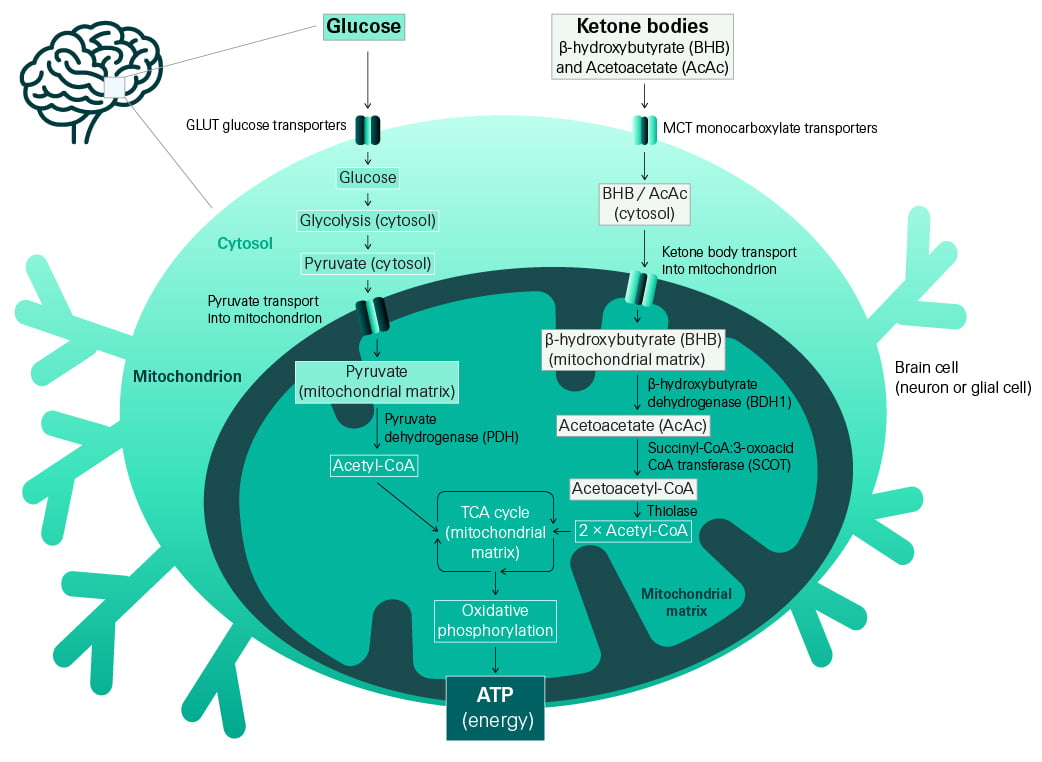
(Created using AI)
One of the leading researchers in this field, Professor Stephen Cunnane describes the "brain energy rescue" hypothesis: providing an alternative fuel to compensate for impaired cerebral glucose metabolism10.
Ketones do not however completely replace glucose. In healthy adults placed on a very ketogenic diet for four days, blood ketones levels increased roughly eightfold and ketones were estimated to supply approximately one-third of brain energy under those conditions. At the same time, cerebral glucose metabolism fell by about 20%11.
The proportion of brain energy supplied by ketones depends strongly on their circulating concentration and on the body's adaptation to sustained ketosis. During prolonged fasting, studies suggest that ketones can become the brain's predominant fuel, providing roughly half or more of its energy requirements12.
As highlighted, ketone uptake appears to remain relatively intact in Alzheimer's disease. In people with mild-to-moderate Alzheimer’s disease, approximately 30 g/day of MCT supplementation approximately doubled brain ketone consumption, increasing total brain energy supply without increasing glucose metabolism13.
The BENEFIC trial observed essentially the same phenomenon over six months in people with mild cognitive impairment: MCT supplementation increased cerebral ketone metabolism by around 230% while cerebral glucose metabolism remained unchanged14.
Could brain energy rescue improve patient outcomes?
Several small studies have evaluated ketogenic diets, MCT supplementation and ketone esters in people with mild cognitive impairment or Alzheimer’s disease. While results are inconsistent, the studies have different starting points, or different interventions, some studies have reported improvements in selected cognitive and functional outcomes.
The latest study by Tağraf et al. looked at 60 patients with early to mid-stage Alzheimer’s disease and were randomized for 6 months. The intervention (plant-rich ketogenic diet plus intermittent fasting) group gained 0.9 MMSE (mini-mental state examination) points on average while controls lost 1.5 points23.
Longer and larger studies are needed to determine whether these interventions provide sustained cognitive benefits and, importantly, whether they can slow Alzheimer's disease progression.
It is also important to distinguish ketogenic diets from exogenous ketones or substrates like MCTs or ketone esters. All can increase ketone availability, but their wider metabolic effects differ. A ketogenic diet substantially restricts carbohydrate intake and typically lowers glucose and insulin exposure, alongside broader improvements in weight, lipid metabolism and other metabolic markers including inflammation24. MCTs, by contrast, are rapidly converted by the liver into ketones, while ketone esters raise circulating ketones directly. Both MCT and ketone esters can increase blood ketone levels without carbohydrate restriction and hence without the wider metabolic benefits associated with a ketogenic diet.
Case reports suggest potential cognitive benefits from ketone-based interventions in Alzheimer’s disease. A 71-year-old woman with mild Alzheimer’s disease improved her metabolic health and increased her MoCA score from 21/30 to 28/30 after a 10-week ketogenic lifestyle programme25. In another case, a patient with advanced Alzheimer’s disease (MMSE ~12/30) showed improvements in alertness, mood, cognition, self-care, and daily functioning following MCT and ketone monoester supplementation26.
These cases provide interesting signals, but not proof of efficacy. The question of whether the metabolic and cognitive effects observed in small studies and individual patients will translate into broader functional improvement for larger patient groups, whether there will be sustained clinical benefits, and ultimately if disease progression is slowed, will require larger and longer randomised trials.
What about other types of dementia?
Evidence for ketogenic interventions outside Alzheimer’s disease remains very limited. Meta-analyses in this area of research have explicitly excluded vascular dementia, frontotemporal, mixed, subcortical and Lewy body dementia; and vascular, Lewy body and frontotemporal dementia.
However, dementia pathology frequently overlaps, particularly in older people. Alzheimer’s and vascular pathology often coexist. As such, an intervention targeting impaired brain energy metabolism could theoretically benefit the Alzheimer’s disease component of mixed disease.
In addition, particularly with vascular dementia, there is a shared upstream risk. Metabolic disease and its risk factors are strongly linked to vascular dementia – there is an almost 2.5 times increased risk of developing vascular dementia if someone has diabetes25. So, while the treatment argument (metabolic energy rescue) might not be generalisable across dementia types, the prevention lens may be broader.
Conclusion
When considering any treatment or intervention for Alzheimer's disease, the 3 areas one would naturally focus on is functional improvement, slowing disease progression and ultimately the prevention of Alzheimer's disease.
Can a ketogenic diet or exogenous ketones improve symptoms?
Possibly
The concept of metabolic or 'brain energy rescue' is biologically plausible, and though early clinical studies provide encouraging signals, evidence remains limited. Ketogenic diets, MCT and exogenous ketones can increase the brain’s use of ketones, and some studies in mild cognitive impairment and Alzheimer's disease have reported improvements in cognition or daily functioning. However, studies have generally been small and relatively short. Additionally, mild cognitive impairment itself does not necessarily represent early Alzheimer's disease. Larger trials directly comparing different approaches to raising ketones are needed.
Can a ketogenic diet or exogenous ketones slow Alzheimer’s disease?
We do not yet know
While the case for metabolic rescue makes sense, currently there is no evidence to conclude that there is actual disease modification. Sustained ketosis could potentially influence mitochondrial function, insulin signaling, oxidative stress, inflammation, amyloid and tau biology, or myelin integrity. But there is currently insufficient evidence that these effects translate into slower neurodegeneration or disease progression.
These would certainly need longer time frames and require hard outcomes. Such studies would be considerably more financially demanding than the relatively small trials conducted to date. There may be less financial incentive to invest in large, expensive trials, although public health and research entities wanting to improve societal and population health may see the benefit of funding such studies.
What about prevention?
Prevention is perhaps the most intriguing and remains largely untested
There are essentially no trials demonstrating that nutritional ketosis prevents Alzheimer’s disease. However, several observations make earlier metabolic intervention worthy of further study. High fasting glucose is a major modifiable contributor to dementia risk, while impaired brain glucose metabolism can appear decades before symptoms, suggesting a long window for intervention. This has led to interest in ketogenic dietary interventions as a potential area of study.
Because Alzheimer’s disease incidence rises steeply with age, approximately doubling every five years after 65, even a modest delay in dementia could matter. Shifting onset to later life could reduce the number of years people live with cognitive impairment and potentially mean that some individuals never develop clinically significant disease during their lifetime.
Prevention may also be more practical than treatment: changing diet is likely easier for a cognitively intact, metabolically unhealthy middle-aged person than for someone with early or established dementia. The potential benefit extends beyond Alzheimer’s disease, since diabetes is even more strongly associated with vascular dementia. None of this shows that ketogenic diets prevent dementia. What it does show is that metabolic dysfunction is an established dementia risk factor, and that earlier metabolic interventions are a reasonable area for research.
What could this mean for insurance?
For insurers, the key question is whether an intervention can change the course of Alzheimer’s disease in a meaningful way – delaying the onset of diagnosis, cognitive decline, loss of independence, the need for care or ultimately death. There is currently not enough evidence to conclude that ketogenic interventions can do this. If longer-term studies eventually show such an effect, however, the implications for Life & Health insurance could be meaningful.
For life insurance, any sustained change in disease onset, progression or survival could potentially affect mortality experience, although the direction and magnitude would depend on the nature of the clinical effect. Successful treatment could, paradoxically, also increase the number of people living with Alzheimer’s, as more people survive for longer with earlier-stage disease, changing rather than simply reducing the risk profile.
The impact could be greater for long-term care and disability insurance. Much of the burden of dementia occurs when cognitive decline leads to loss of independence and the need for formal care. Even a modest delay in the onset of this transition could influence disease burden and associated healthcare needs, even if it does not prevent Alzheimer’s altogether. This presupposes a later onset or loss of independence is associated with a shorter duration due to a higher age-related mortality risk.
There may also be a broader opportunity for insurers to think differently about risk. Several important dementia risk factors – including diabetes, hypertension, obesity and physical inactivity – overlap with cardiometabolic disease. If improving metabolic health, or providing alternative brain fuels, is eventually shown to delay cognitive decline, continued attention to the relationship between lifestyle, nutrition and dementia risk remains relevant to insurers and other stakeholders. What ultimately matters is whether an intervention can delay dementia, preserve independence, postpone the need for care or extend life.
New Alzheimer's drugs understandably attract considerable attention because of their potential implications for patients and insurance portfolios. The emerging science of brain energy metabolism deserves attention too. It is much too early to conclude that nutritional ketosis can prevent or modify Alzheimer's disease, but the combination of biological plausibility, early clinical signals and the wider benefits of metabolic health makes it an area worth watching.
References
References
1 WHO dementia fact sheet
2 WHO Leading causes of death
3 Alzheimer's Association 2026 facts and figures
4 https://www.nature.com/articles/s41392-024-01911-3
5 https://www.nature.com/articles/s43587-024-00611-5
6 GBD 2021 Nervous System Disorders Collaborators. Global, regional, and national burden of disorders affecting the nervous system, 1990–2021. Lancet Neurol. 2024
7 https://www.mckinsey.com/mhi/our-insights/the-path-toward-a-metabolic-health-revolution
8 Appraising the brain's energy budget - PubMed
9 Castellano et al. - PubMed
10 Cunnane et al., Nature Reviews Drug Discovery
11 Ketogenic diet brain fuel PET study - PubMed
12 Brain metabolism during fasting - PubMed
13 Croteau et al. - PubMed
14 BENEFIC imaging trial - PubMed
15 Henderson et al., 2009
16 Taylor et al., 2018
17 Fortier / BENEFIC imaging, 2019
18 Phillips et al., 2021
19 Fortier et al., 2021 cognition
20 BENEFIC white matter
21 Johns Hopkins modified Atkins, 2024
22 BREAK-AD, 2026
23 Tagraf et al., 2026
24 Long-Term Effects of a Novel Continuous Remote Care Intervention Including Nutritional Ketosis for the Management of Type 2 Diabetes: A 2-Year Non-randomized Clinical Trial - PubMed
25 Diabetes as a risk factor for dementia and mild cognitive impairment: a meta-analysis of longitudinal studies - PubMed
Tags
Authors
