

Blog(Click here to get to the blog overview page)
Real-World Validation of Tsunami Hazard Data: Kamchatka Earthquake & CatNet® Insights

29 Sep 2025
Tsunamis are infrequent by nature, which makes real-world validation of hazard data a rare occurrence. However, the recent magnitude 8.8 earthquake off the Kamchatka Peninsula in eastern Russia stands out as such a case.
The quake triggered a tsunami across the Pacific Ocean, and while coastal regions felt the impact, this tsunami was fortunately minor compared to the 2011 magnitude 9.0 Tohoku earthquake and tsunami – one of the most devastating in recent history.
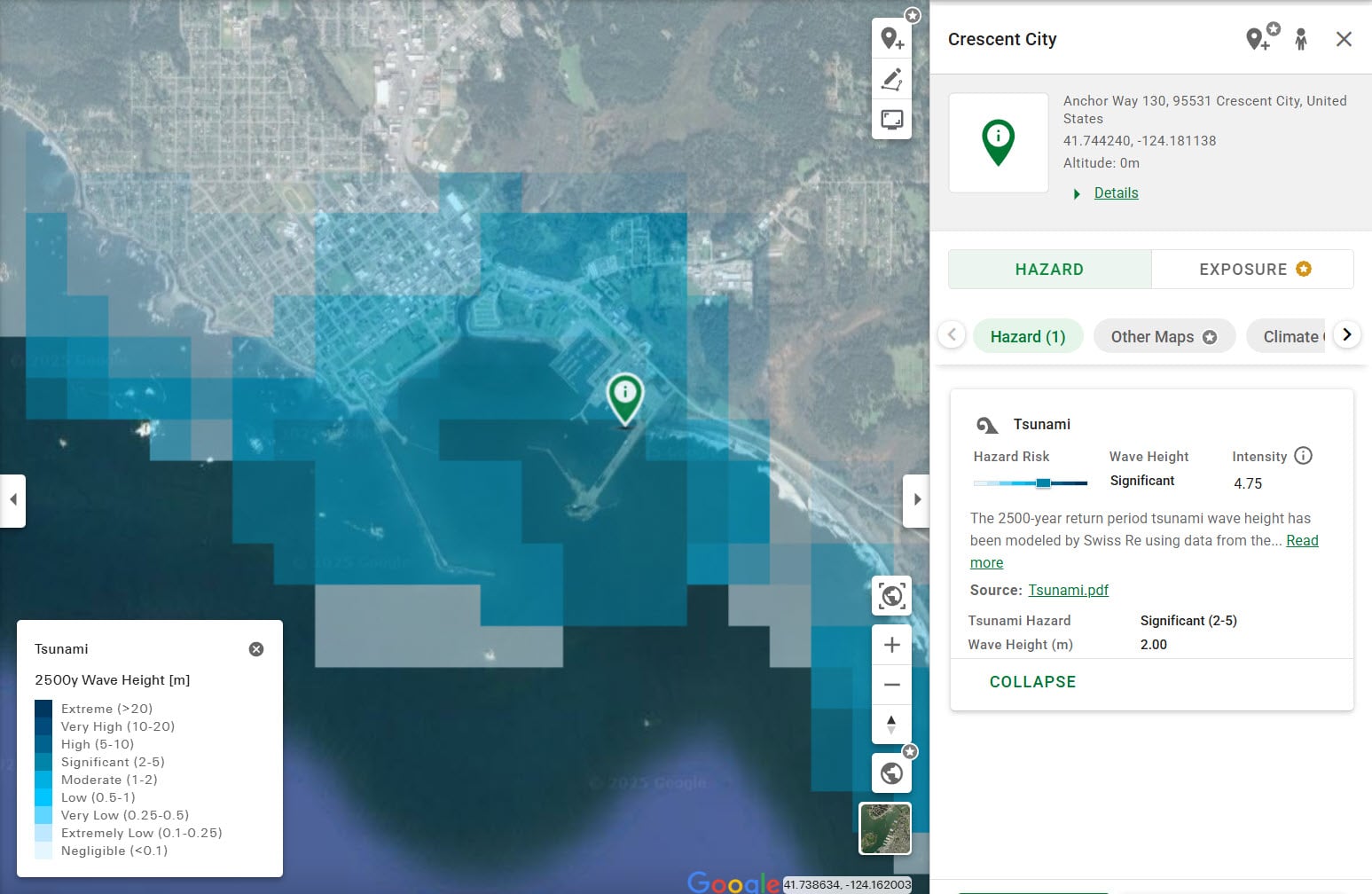
This latest event provided valuable validation for tsunami modeling tools. In the continental United States, Crescent City, California, recorded the highest wave height: 1.22 meters (approximately 4 feet). Given the town's history with significant tsunami events, this impact was not unexpected.
Remarkably, just days after the earthquake and tsunami, the Krasheninnikov Volcano in Kamchatka began a pyroclastic eruption — the first since 1550 CE, according to the Smithsonian’s Global Volcanism Program, the source of the volcanoes hazard data in CatNet®.
CatNet®: Supporting Hazard Assessment with Science-Backed Data
CatNet® is a hazard intelligence platform used by underwriters, risk engineers, and organizations across both the private and public sectors. It supports risk selection and strategic planning through access to data across a wide range of natural hazards, including:
- Earthquakes
- Floods
- Wildfires
- Windstorms
- Convective storms
- Geological events (like tsunamis and volcanoes)
CatNet® API and Web provide an enhanced global tsunami hazard layer, providing wave height data critical for assessing potential damage.
According to CatNet®, tsunami wave heights of up to two meters are possible in the Crescent City harbor at a 2,500-year return period. The observed four-foot (1.22 meters) tsunami wave in Crescent City resulting from the Kamchatka earthquake is within the expected range of potential tsunami wave heights.
The Kamchatka earthquake, one of the ten largest earthquakes recorded since 1900, was significantly smaller than the 2011 9.0 magnitude Tohoku event, so it is still possible for even larger tsunami waves to impact the city.
crescent tsunami wave
Geological Context: Kamchatka Seismic Cluster and Volcanic Activity
In the Kamchatka region, the CatNet® Events collection shows three earthquakes events, ranging from magnitude 6.8 to 8.8, occurring between July 7 and August 2. These earthquakes are closely aligned with active reverse fault lines, where the Pacific Plate subducts beneath the Okhotsk Plate.
This tectonic activity is directly linked to the eruption of the Krasheninnikov Volcano and mirrors the geological processes forming the Cascade Mountain Range in the United States, from California to Washington. The same subduction process led to notable eruptions such as Mount St. Helens in May 1980.
kamchatka earthquake hazard data

The ‘Events’ component of CatNet® offers event information for hazards including:
- Tropical cyclones
- European winter storms
- Earthquakes
- Floods
- Rainfall events
Conclusion
Our global, web-based exposure analysis and mapping tool enables you to assess and visualise your natural hazard exposure for any location in the world and assess your accumulation across entire portfolios. Tools like CatNet® are essential in a world where natural hazards can emerge suddenly, but their impacts can be better managed through reliable, science-based data.
Tags
Get in touch Want to see how CatNet® helps validate hazard data in real time?