


Close Call
Protection gaps are still proving hard to close, say Melissa Leitner – but if we focus specifically on each market's problems, we can tailor the three As appropriately: affordability, accessibility and availability.
Article information and share options
This article was written
By
During my two decades in the life insurance industry, it's become clear to me that re/insurers struggle to shrink protection gaps. I feel strongly that we must move beyond simply measuring the size of mortality and health protection gaps and start considering the factors that cause them.
In 2008, as the world plunged into recession, I was working in my first actuarial job at a South African life insurance company, while completing my professional exams. Looking back at the historical protection gap data, a few things stand out.
In the two years after the crisis, the global household assets available to support the financial needs of family members adjusting to the death of a breadwinner, plus the protection afforded by life policies, dropped from 50% to 47% of what was needed to cover wage replacement and household debt. Strikingly, the most recent numbers have hardly changed - in fact, by 2021 they had slipped to just 46%. The decline is mostly explained by the fact that insurance growth has been outpaced by rising consumer need in emerging markets. Put simply, mortality protection gaps are widening.
Addressing such protection gaps has long been a challenge for our industry, leaving unserved and underserved communities vulnerable. (Re)insurers lose out on growth prospects in markets or segments of markets where protection needs are left unaddressed and financial inclusion remains low. If we can understand the key drivers behind the gaps, we'll be better equipped to close them.
As one of the authors behind the Swiss Re Institute's research paper "The Life & Health Insurance Inclusion Radar", I really wanted to understand the factors that lead to protection gaps. Both Swiss Re and the wider insurance industry have long invested resources into quantifying protection gaps to show the scale of potential demand but generally focused less on identifying which market features and forces positively or negatively influence whether we are serving people from across society in an inclusive way.
The three As
In the research, we set out to understand the levels of inclusivity in a heterogeneous mix of 16 important insurance markets in advanced and emerging economies, and based on three decisive dimensions of inclusion: availability, accessibility and affordability – 'the three As'.
For instance, we examined how a wide product range, as well as innovation that focuses on underserved communities, makes insurance more available to all. We also looked at the role of financial literacy in ensuring people have access to protection, whether established distribution methods employ diverse talent, and how regulatory incentives and support can meaningfully impact affordability.
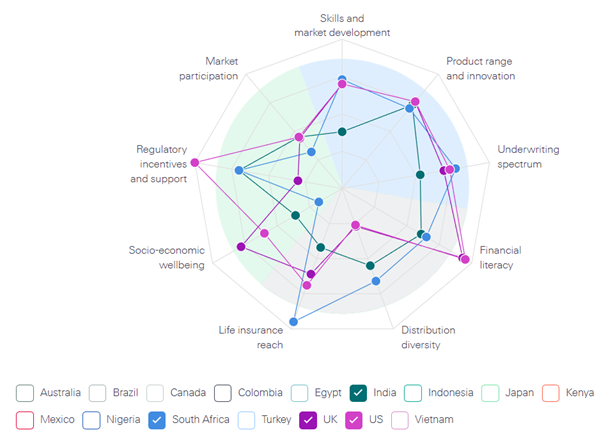
By using consistent, objective and transparent measures to assess each market, the report highlights where inclusion deficits crop up as potential barriers to would-be customers. It provides a visual representation of inclusion for each market, allowing candid examination of their strengths and weaknesses – as well as insights on where efforts to remedy weaknesses should be focused, with possible inspiration from strengths of other markets.
For instance, the South African insurance market is among the world's most vibrant - it's more than 150 years old and has navigated tremendous social and economic transformation during that time. And while the Inclusion Radar captures many of the things you'd expect in such an established market – for example, South Africa scores higher for insurance inclusion than many more advanced economies – it also illuminates key weaknesses in the country. South Africa performs worse on the affordability of life insurance than all other markets studied except for Colombia, a phenomenon driven by high unemployment and deep social inequality.
Reaching the underserved
In the US, by contrast, the Insurance Radar identifies lagging insurance accessibility as a key factor in our inability to reach underserved groups. For instance, it shows that the US market is held back by a lack of diversity in the insurance workforce. Reaching diverse communities will require new approaches to be taken, including recruiting talent from a broad range of backgrounds to ensure greater understanding of the challenges, as well as the opportunities for products to boost resilience within underserved communities..
India is the most populous of the emerging markets studied and ranks sixth overall. While there is room for improvement in all dimensions of the three As, external barriers are relatively low compared with many other markets. Furthermore, India's insurance supervisor is pushing for all Indians to be insured over the next quarter of a century. That makes India an attractive growth market, with approximately 400 million people making up the so-called "Missing Middle" between India's poorest and wealthiest inhabitants.
We also charted the UK's insurance market. Like many advanced markets, it performs well on availability: for instance, the local product range is very good, as are the development opportunities for industry workers. Nonetheless, its inclusion scores are dragged down by its lack of distribution diversity, hindering accessibility, and insufficient regulatory incentives and support, hindering affordability.
Underperformance in these areas prevents the UK market from being highly inclusive, but it is not alone in this: none of the 16 focus markets are fully inclusive.
A more optimistic future
By spotlighting the impediments to more inclusive propositions and practices in each market, the Inclusion Radar proposes clearer paths forward to complement any quantification of protection gaps.
As an industry, we can:
- Strive to better understand the needs of vulnerable and underserved communities with via consumer-focused research.
- Forge strategic partnerships that boost workforce and distribution channel diversity.
- Ensure that resource invested in underwriting and product innovation prioritises simplification and efficiency, and thus affordability.
- Foster a healthy dialogue with regulators to ensure innovation can proceed constructively while consumer protections remain robust.
A colleague and fellow actuary once described the life insurance business to me in a powerful way: “We help orphans and widow(er)s.” That is an inspiring purpose and, if successful, it has the ability to uplift not just families but also communities and entire societies.
Data on protection gaps show us just how much untapped potential there is in boosting societal resilience. The Inclusion Radar aims to provide additional objective perspectives on where the industry should focus to provide an optimistic and more inclusive future.
Figure 1
Note: This article was first published at The Actuary, July 2023
Tags
Contact Author
